What is The Red Spot On Jupiter? Here’s What to Know Now
For centuries, the red spot on Jupiter has captivated astronomers and space enthusiasts alike.
This awe-inspiring feature, known as the Great Red Spot, has been swirling and churning on the gas giant’s surface for more than 300 years, defying our expectations with its enduring presence.
This article will swirl around the intriguing facts surrounding the enigmatic storm, seeking answers to the question that has puzzled scientists for generations:
Why is the red spot on Jupiter still active, constantly raising fascinating scientific inquiries about its origins, mechanisms, and potential future?
Join us on a journey through the mysteries of the Great Red Spot as we unravel its secrets and explore the remarkable forces that sustain its relentless energy.
The Red Spot on Jupiter: Understanding Jupiter
Planet Jupiter is the largest planet in our solar system and the fifth planet from the Sun and named after the Roman god of sky and thunder.
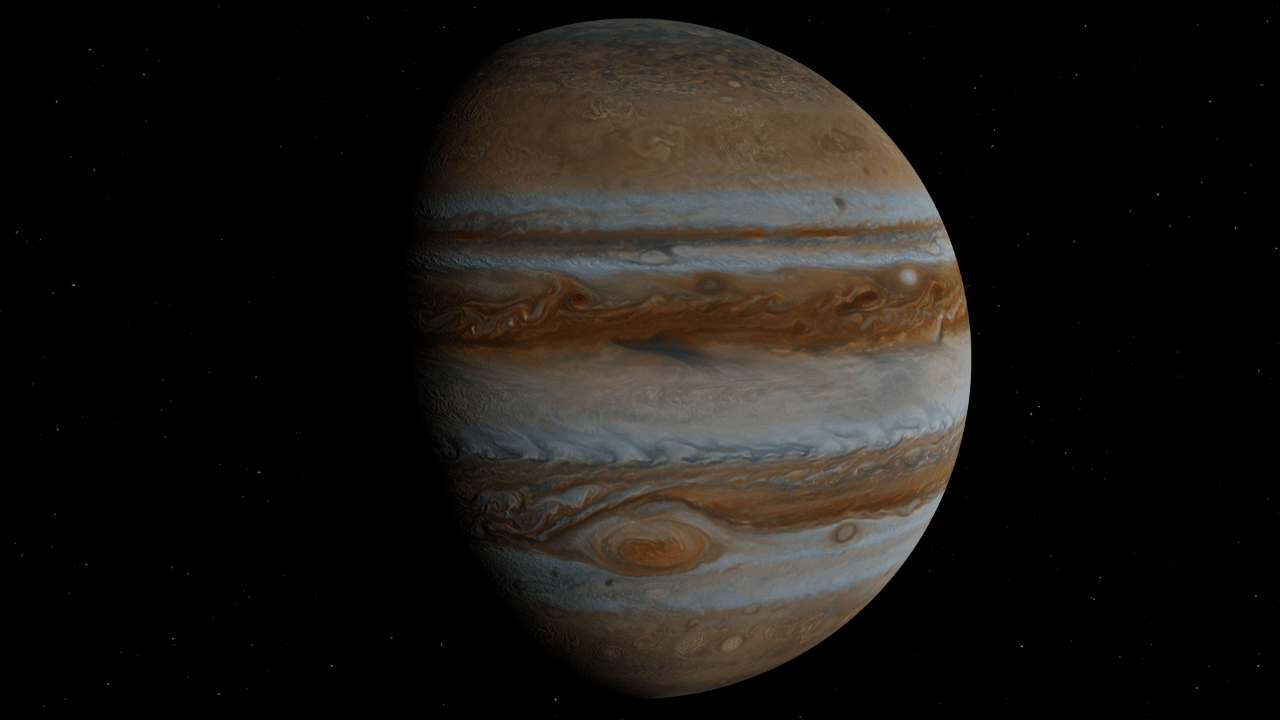
Jupiter’s atmosphere is known for its distinctive bands of clouds, including the iconic Great Red Spot, a massive storm that has been observed for centuries.
The Red Spot on Jupiter: A Behemoth Among Planets
With a diameter of about 143,000 kilometers (88,800 miles), it is more than 11 times wider than Earth.
Jupiter’s immense size and intriguing features make it a subject of ongoing scientific research and exploration, contributing to our understanding of the vast universe we inhabit.
Being one of the brightest objects in the night sky, Jupiter has captivated humans throughout history.
It plays a significant role in shaping the dynamics of the solar system and provides valuable insights into planetary formation, atmospheric processes, and the diversity of celestial bodies.
What is That Red Spot on Jupiter?
Nestled in the southern hemisphere of Jupiter lies a captivating phenomenon known as the Great Red Spot.
With its distinctive shape resembling a “pancake,” this powerful anticyclonic high-pressure system commands attention as it relentlessly swirls counterclockwise.
Its ferocious winds, clocking in at a staggering 430 to 680 kilometers per hour (270 to 425 miles per hour), evoke both fascination and awe.
Tracking this colossal storm for over 150 years, scientists remain puzzled about its origins, wondering if it predates our earliest records.
A Changing Beast
While the Red Spot on Jupiter has gained notoriety for its voracity, even devouring smaller Jovian storms, recent observations suggest a change in its size, gradually shrinking to a scale just larger than Earth.
The massive storm that is the red spot on Jupiter, is larger than Earth and was first spotted in 1830.
Meanwhile, observations from the 1600s also revealed a giant spot on Jupiter’s surface which could have been the same storm system.
Hence, we can conclude that the red spot on Jupiter has been raging for centuries.
The Red Spot on Jupiter: Why is the Spot on Jupiter Red?
You might be wondering why the spot is red. It is revealed that The Spot’s surface is concealed by a dense layer of haze or clouds, suggesting the involvement of photochemical products akin to smog.
Conflicting explanations arise regarding the captivating hue of the Great Red Spot.
While some scientists propose that buried chemicals beneath the storm’s cloud tops create the reddish tint, others argue that sunlight’s interaction with various compounds in the upper atmosphere might be responsible, implying that the remainder of the Great Red Spot may not be as prominently red. It is plausible that what we perceive as the vibrant “sunburn” hue resides solely at its uppermost reaches.
Inside the Red Spot on Jupiter
Another common question is what is going on inside the red spot on Jupiter.
Recent observations and analysis of the Great Red Spot on Jupiter have revealed intriguing developments inside the massive storm.
The Changing Dynamics of the Red Spot on Jupiter
In 2019, amateur astronomers noticed portions of the storm “flaking” off, raising questions about its stability.
Researchers, utilizing Hubble Telescope data from 2009 to 2020, investigated the storm’s velocity fields and confirmed an approximately 8% increase in winds in the outermost lane or high-speed ring surrounding the storm, while slower movements were observed near the storm center.
These findings challenge initial expectations of wind conservation and suggest a complex interplay of stretching and accelerated spinning. However, the continuous nature of these trends and their potential impact on the eventual fate of the Great Red Spot remain uncertain.
Diminishing Size
Over the years, measurements have depicted the GRS’s significant size reduction, with recent observations from the Hubble Space Telescope revealing its current dimensions of approximately 8,000 miles from top to bottom and 10,250 miles across.
The storm has transformed from an oval shape to a more circular form, shrinking by 580 miles per year along its major axis.
At this rate, it is anticipated that the storm will become completely circular within four years, although the fate of such storms is challenging to predict accurately due to their intricate dynamics.
How Long Will The Red Spot on Jupiter Last?
Experts say that the red spot on Jupiter may disappear in the next 20 or so years.
However, determining the lifespan of Jupiter’s red spot poses a significant challenge due to the limited tools currently available to scientists.
The Hubble Telescope’s observations are constrained by the cloud tops, offering little insight into the inner workings of the Great Red Spot and hindering our understanding of its longevity.
The Red Spot on Jupiter: Exploring the Enigmatic Interior
While measuring the depth of the storm could provide valuable context, spacecraft estimates have yielded ambiguous results.
NASA’s Juno mission in 2017 estimated the depth of the spot to be “50 to 100 times deeper than Earth’s oceans,” but the exact boundaries and endpoint of the storm remain elusive.
As a result, the duration of the Great Red Spot’s existence remains uncertain, and predicting its future remains a complex task that requires further investigation and advancements in observational techniques.
Related articles:
- How Was Planet Mercury Discovered – HOW DID WE KNOW?
- The Mysterious Rings of Saturn: What are They Made of, and How Do They Work?
The Red Spot on Jupiter: Other Basic Facts About Jupiter
Jupiter, the largest planet in our solar system, has long captivated the imagination of scientists and stargazers alike. With its immense size, vibrant atmospheric features, and intriguing mysteries, Jupiter holds a prominent place in our quest for cosmic understanding. Learn more about this colossal planet of the Solar System.
Fact #1: Jupiter’s distance from Earth varies due to their respective orbits around the Sun.
On average, the distance between the two planets is about 484 million miles.
However, during opposition when Earth and Jupiter are on the same side of the Sun, the distance can be as close as 365 million miles, while during conjunction when they are on opposite sides of the Sun, the distance can be as far as 601 million miles.
Fact #2: Thousands of Earths can fit inside Jupiter!
Approximately 1,321 Earths could fit inside Jupiter, making it over 11 times the diameter of our home planet.
To put it into perspective, Jupiter has a diameter of about 86,881 miles, while Earth has a diameter of roughly 7,918 miles.
Fact #3: Jupiter is primarily made of gas.
Jupiter is primarily composed of hydrogen and helium, similar to the composition of the Sun. These two elements make up the vast majority of its mass.
In addition to hydrogen and helium, Jupiter also contains trace amounts of other compounds such as methane, water vapor, ammonia, and other hydrocarbons.
The exact proportions of these elements and compounds in Jupiter’s atmosphere and interior are still a subject of ongoing research and exploration.
Fact #4: Jupiter has shorter days than Earth.
Jupiter has a rapid rotation, completing a full rotation on its axis in just under 10 hours. This fast rotational speed gives Jupiter its distinctive flattened shape and causes its equator to bulge out.
Meanwhile, Earth takes about 24 hours to complete one rotation.
Fact #5: Jupiter’s atmosphere is a turbulent and extreme.
Near the cloud tops, the temperature can average around -234 degrees Fahrenheit (-145 degrees Celsius).
However, as one descends deeper into Jupiter’s atmosphere, the pressure and temperature increase dramatically.
In the planet’s core, temperatures may reach tens of thousands of degrees, with immense pressure due to the planet’s massive gravity.
Fact #6: The discovery of Jupiter dates back to ancient times.
It is challenging to attribute its discovery to a single person. However, the precise understanding of Jupiter as a planet evolved over centuries.
Ancient civilizations, including the Babylonians and ancient Greeks, observed Jupiter in the night sky.
The Italian astronomer Galileo Galilei made significant discoveries about Jupiter and its moons in 1610 when he observed the planet through a telescope.
His observations of the four largest moons of Jupiter, now known as the Galilean moons (Io, Europa, Ganymede, and Callisto), revolutionized our understanding of the solar system.
Fact #7: Jupiter has up to 95 moons!
Most counts reveal that Jupiter has up to 95 moons.
The four largest moons discovered by Galileo—Io, Europa, Ganymede, and Callisto—are known as the Galilean moons and are the most well-known.
These moons have their own distinctive characteristics, with Europa being of particular interest due to the possibility of an underground ocean.
The remaining moons vary in size, composition, and orbit.
Fact #8: Jupiter does have water.
Jupiter, despite lacking a solid surface, does contain water in its atmosphere. While the planet doesn’t possess oceans or poles like Earth, the presence of water on Jupiter refers to water vapor or ice within its expansive clouds.
Approximately 0.25% of the molecules in Jupiter’s atmosphere consist of water vapor stored in its cloud tops.
Although this percentage may seem small, given Jupiter’s colossal size, it amounts to a significant quantity of water.
Fact #9: Jupiter has rings.
Jupiter boasts a retinue of numerous moons encircling its colossal form. In addition, this gas giant possesses a set of rings, although they differ from Saturn’s renowned rings.
Jupiter’s rings, composed of delicate dust particles instead of ice, exhibit a subtle and understated nature in comparison to Saturn’s resplendent icy rings.
Fact #10: Jupiter is not conducive to life.
Jupiter, with its extreme temperatures, pressures, and volatile conditions, is highly unlikely to be a habitable environment for life as we know it.
However, the same cannot be said for some of Jupiter’s intriguing moons. Among them, Europa stands out as a promising candidate for potential extraterrestrial life.
Beneath its icy crust, substantial evidence points to the existence of a vast ocean, which could potentially harbor the conditions necessary to support life.
While Jupiter itself may not be livable, the exploration of its moons, particularly Europa, offers an exciting prospect for discovering life beyond Earth within our own solar system.
Frequently Asked Questions
What are the names of Jupiter’s moons?
Jupiter’s four largest moons are named Io, Europa, Ganymede, and Callisto. Scientists did not give the smaller moons names “unless they are of significant scientific interest”, according to NASA.
Why are planets named after gods?
Planets are named after gods due to the historical influence of ancient civilizations, particularly the Romans and Greeks. Jupiter, the largest planet, shares its name with the mighty king of the gods, highlighting its dominance in the solar system.
Can we live inside Jupiter?
No, it is not possible for humans or any known form of life to live inside Jupiter. Jupiter is a gas giant composed mainly of hydrogen and helium, with no solid surface to support life. Jupiter’s environment is marked by violent storms, high levels of radiation, and a lack of essential elements and conditions necessary for life to survive.
How do we determine the planets’ (including Jupiter) age?
The method of crater counting offers insights into the relative ages of their surfaces rather than the absolute age of the planet itself. Factors such as a planet’s proximity to the asteroid belt may result in more frequent impacts. By comparing different regions of a surface, scientists can estimate relative surface ages through the technique of crater counting.
Takeaway
Studying the Great Red Spot on Jupiter provides valuable insights into the dynamic nature of planetary atmospheres and the complex behavior of storms.
By observing and analyzing this massive storm system, scientists can gain a deeper understanding of atmospheric processes, such as high-pressure systems and anticyclones, and their evolution over time.
The Red Spot’s longevity and continuous monitoring offer an opportunity to investigate the mechanisms that sustain such persistent storms.
Studying the Red Spot’s changing size, shape, and internal dynamics provides valuable data for improving our understanding of atmospheric circulation patterns and the interaction between different layers of Jupiter’s atmosphere.
The information gleaned from the Red Spot contributes to our broader knowledge of planetary weather systems and enhances our ability to model and predict weather phenomena both on Jupiter and potentially on other gas giant planets.
Ultimately, unraveling the mysteries of the Red Spot on Jupiter expands our knowledge of planetary dynamics and provides valuable comparative insights into weather phenomena across the universe.
If you found this article informative, consider subscribing to our YouTube channel for more mind-blowing and thought-provoking content.
More articles:




Discussion about this post