Secrets Unveiled: Discovering the Lesser-Known Facts about Planet Neptune
Planet Neptune, the eighth planet from the Sun, remains a mystery to astronomers and the general public alike. Despite being one of the four gas giants and sharing many characteristics with its peers, Planet Neptune has several surprises up its sleeve, making it a fascinating object of study.
Neptune was discovered by Jean-Joseph Le Verrier and Johann Galle in September 1846. The planet is named after the Roman god of the sea, and it lives up to its namesake: Neptune has the strongest winds in the solar system, with speeds of up to 2,100 kilometres per hour.
It is also the coldest planet, boasting a temperature as low as -224 degrees Celsius. One of Planet Neptune’s most intriguing features is its peculiar orbit. Unlike other planets, Neptune’s rotation axis is tilted at an angle of 28 degrees relative to its orbit around the Sun.
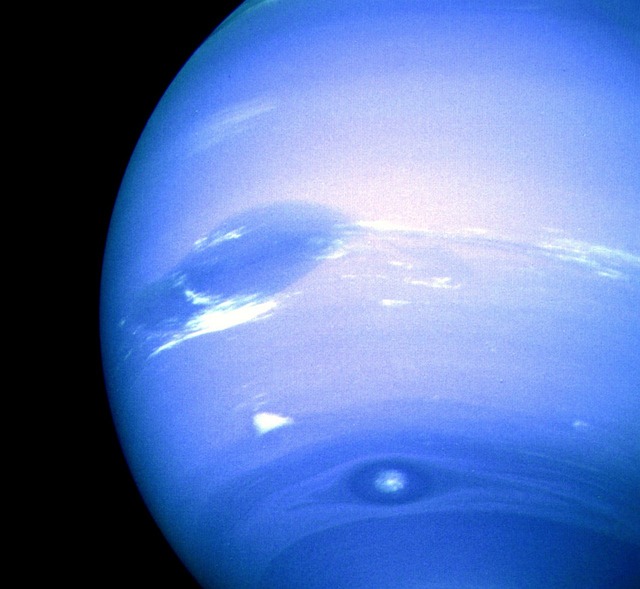
This has led to some speculation that the planet may have been knocked off course by a rogue planet or a large moon, but the cause remains unknown. Neptune is also home to one of the solar system’s most enigmatic features: a great dark spot.
Much like Jupiter’s famous red spot, this feature is a giant storm that has been raging for at least two centuries. However, unlike the red spot, the dark spot is not a permanent fixture and has been observed to disappear and reappear over time.
As we learn more about Neptune, we are sure to uncover more secrets about this fascinating planet. From its icy blue hue to its mysterious features, Planet Neptune has captured the imagination of scientists and storytellers alike, and it will continue to do so for years to come.
Planet Neptune’s Formation and Composition
Planet Neptune is the eighth planet in the solar system, and it garners little attention compared to its gaseous neighbors, Saturn and Jupiter.
However, this ice giant has a unique charm that deserves attention. A close exploration of Planet Neptune uncovers fascinating facts about this blue planet, from its formation to its unpredictable weather and mysterious rings.
The Origin of Planet Neptune
Unlike terrestrial planets like Earth, Planet Neptune belongs to the category of gas giants, an intriguing classification with a unique formation process. Scientists have theorized that Neptune formed almost 4.5 billion years ago from the solar nebula.
It emerged from the gravitational collapse of the gas and dust in the nebula, forming a partial rock and ice core, which later accumulated more gas and ice, leading to its current mass. This remarkable process of formation is what sets gas giants like Planet Neptune apart from their solid counterparts.
While terrestrial planets are primarily composed of rock and metal, gas giants consist primarily of hydrogen and helium, with only a small fraction made up of heavier elements. The formation of Neptune involved the aggregation of gas and ice over millions of years, gradually attracting more material until it reached its present size.
The immense gravity of the growing gas giant pulled in surrounding gases and dust, creating a thick atmosphere that envelops the solid core.
This unique composition gives Neptune its characteristic bluish hue and turbulent weather patterns, making it a captivating subject of study for astronomers and planetary scientists alike.
By delving deeper into the formation of gas giants like Neptune, scientists hope to gain a better understanding of the processes at play during the early stages of our solar system’s evolution.
Composition of Planet Neptune
Neptune, known as the eighth planet from the sun, is composed mainly of hydrogen, helium, and methane gases. Its composition is unique, with a rock and ice core constituting about 20% of its mass.
It is fascinating to consider how the high pressure at the planet’s core creates a distinctive form of water that is believed to conduct electricity. This phenomenon plays a crucial role in generating Planet Neptune’s magnetic field, an awe-inspiring characteristic of the planet.
Additionally, the captivating blue hue of Neptune is a result of the absorption of red light by the atmospheric methane. This interaction between light and methane gives the planet its stunning blue-green glow, making it a truly mesmerizing celestial body in our solar system.
Differences Between Planet Neptune and other gas giants
Planet Neptune’s composition differentiates it from other gas giants in several ways. It is the smallest of the four gas giants, with a mass seventeen times that of Earth.
Unlike Saturn and Jupiter, Neptune lacks a visible atmosphere layer, making rock and ice layers visible. Also, while Jupiter and Saturn rotate rapidly, a single day on Neptune lasts almost eighteen Earth hours.
Planet Neptune’s story is fascinating, and there is much more to explore. Let’s take a look at its moons and rings and see what’s unique about them.
Planet Neptune’s story is indeed fascinating, but the exploration doesn’t stop with its composition and differences from other gas giants. The planet’s moons and rings hold their own intrigue and uniqueness.
Neptune has a total of 14 known moons, the largest of which is Triton. Triton is not like other moons in our solar system. It has a retrograde orbit, meaning it orbits in the opposite direction of Neptune’s rotation.
This suggests that Triton was actually a captured object, possibly a dwarf planet or a Kuiper Belt object that Neptune’s gravity pulled into its orbit. Triton is also known for its icy surface, which is covered in nitrogen frost and geysers that erupt with nitrogen gas.
Another moon of interest is Nereid, which is the third-largest moon of Neptune. Nereid has a highly eccentric orbit, meaning it is not perfectly circular but rather elongated, bringing it as close as 1.37 million kilometers and as far as 9.67 million kilometers from Neptune. This irregular orbit makes Nereid quite difficult to study and understand fully.
But it’s not just the moons that make Neptune intriguing. The planet is also surrounded by a system of rings, although they are much fainter and less prominent than Saturn’s magnificent rings.
These rings are made up of small particles, likely ice and dust, that are spread across a broad area. They are segmented into five main bands, which are named after the scientists who made significant contributions to Neptune’s study, such as Galle and Lassell.
The most remarkable feature of Neptune’s rings is the presence of ring arcs, which are incomplete portions of rings that seem to be maintained by the gravitational pull of nearby moons. These arcs are dynamically unstable and constantly changing shape, providing ongoing interest and research opportunities for scientists.
So as we delve deeper into Neptune’s story, it becomes evident that there is so much more to discover and understand about this distant gas giant. Its moons and rings offer a wealth of mysteries waiting to be unraveled, leaving us eager to continue exploring this enchanting world.
Planet Neptune’s Moons and Rings
Neptune is known for its vast and mysterious moon system. The planet has 14 confirmed moons, which are all named after mythological sea creatures. Additionally, there are several moons that are yet to be confirmed, making the total number of moons around Neptune 80.
Notable Moons of Planet Neptune
One of the most notable moons of Planet Neptune is Triton. It is the largest of Neptune’s moons, and it is also one of the coldest objects in the solar system, with a surface temperature of about -235 degrees Celsius.
Triton is unique because it is the only large moon in our solar system that orbits its planet in the opposite direction of the planet’s rotation.
This suggests that Triton was not formed alongside Neptune and was captured by its gravitational pull. Nereid is another interesting moon of Neptune. It has an uncharacteristically large and elongated orbit compared to other moons in the solar system.
Scientists have suggested that Nereid is a captured object, as well, but from the Kuiper Belt, a region beyond Neptune that contains icy bodies.
Mysterious Rings Surrounding Neptune
Neptune also possesses rings, although they are much fainter than the iconic rings of Saturn. It was discovered in 1984 when Voyager 2 visited the planet.
The rings are named after astronomers who made important contributions to the study of Neptune: Galle, Le Verrier, Lassell, Arago, and Adams.
The exact origins of these rings are still unknown, but scientists believe they may be made up of ice particles and dust, similar to the rings of other gas giant planets.
Planet Neptune’s Weather and Atmosphere
Unlike its neighbouring planets, Neptune’s atmosphere is one of the coldest in our solar system, with temperatures averaging around -220 degrees Celsius.
But don’t let the cold deceive you; Neptune’s atmosphere is also home to some of the fastest winds in the solar system, reaching speeds of up to 1,200 miles per hour! The composition of Neptune’s atmosphere is similar to that of Uranus, primarily consisting of hydrogen, helium and methane gases.
However, it is the presence of methane that gives Neptune its unique blue colour. The methane gas in Neptune’s atmosphere absorbs red light, reflecting only blue light back into space, making it a beautiful sight to behold.
But why is methane such a significant player in Neptune’s atmosphere? Well, methane creates a greenhouse effect that causes the planet’s temperature to remain stable.
Additionally, it is believed that violent storms and wind currents contribute to the creation of the planet’s dark spots, which are massive storm systems that form and dissipate regularly. Speaking of storms, Neptune’s weather is incredibly unpredictable!
Since it takes just under 16 hours for Neptune to make one complete rotation, its wind currents are highly disruptive. These winds create incredible weather phenomena, including large-scale storm systems and banded cloud formations. Neptune may be the farthest planet from the sun, but it is a planet that is full of surprises.
Despite its cold temperature, it is home to some of the fastest winds and most violent storms in our solar system, which can be attributed to the presence of methane gases. So the next time you look up at the sky, take a moment to appreciate the beauty and complexities of Neptune!
Neptune’s Exploration and Future Missions
Neptune is the eighth and farthest known planet from the sun in our solar system. While this blue-hued planet is shrouded by mystery and intrigue, it has attracted the attention of astronomers over the decades.
Experiments and explorations of this planet have yielded valuable insights into its composition and origin. In this section, let’s explore Neptune’s Exploration and Future Missions.
The exploration of Neptune is a relatively recent phenomenon. Despite its distance from Earth and the lack of technology to explore it in previous centuries, the planet has had a few missions to it.
They’ve given invaluable insights into the mysterious planet. In 1989, NASA’s Voyager 2 spacecraft was the first to pass by the planet, photographing and studying its moons and rings.
Since then, Neptune has been a region of wide interest to scientists. Several potential missions to Neptune are on the horizon, thanks to advanced technological developments in the field of space exploration.
The James Webb Space Telescope (JWST) has created much buzz in this area as it is equipped with a near-infrared camera that can study the planets in our solar system. This telescope will likely provide valuable insights into Neptune’s atmosphere, which will prove useful for upcoming missions.
Another upcoming mission is the Trident, a probe designed to fly by Neptune’s moon, Triton. With its icy surface and water vapour geysers, Triton is considered a relevant region to be explored in the search for extraterrestrial life.
The Trident’s advanced imaging and thermal instruments will study the composition of the surface while also trying to understand the complexities of the moon’s orbit and whether there might be a subsurface ocean on the moon. The importance of exploring Neptune lies in understanding the planet’s evolution and composition. The planet holds the answers to many fundamental questions, such as how planets form and change over time.
Furthermore, Neptune and Uranus are distinct from the other gas giants in our solar system, namely Jupiter and Saturn. Studying Neptune can lead to a better understanding of the physical and chemical diversity of gas giant worlds, which is essential in comprehending how planets are formed.
As humans, we are always looking to expand our understanding of the universe. Neptune may appear to be just a mere blue dot in the sky, but it has a lot of secrets to offer that can yield precious insights into the worlds beyond our planet.
With the upcoming potential future missions, we can hope to reveal much about this enigmatic planet and its moon system, thus coming one step closer to unlocking the mysteries of the universe.
Neptune’s Magnetic Mysteries
Neptune’s magnetic field is unlike any other in our solar system. While the magnetic fields of planets like Earth and Jupiter are relatively simple and predictable, Neptune’s magnetic field is strangely irregular.
It is also tilted at a whopping 47 degrees, which means that it is almost parallel to the planet’s rotational axis. Scientists have been trying to unravel the mysteries of Neptune’s magnetic field for decades, but it remains one of the most enigmatic objects in our solar system.
Despite years of study, scientists are still trying to understand the complex nature of Neptune’s magnetic field. One possibility is that the strange tilt of the planet’s magnetic field is caused by deep convection currents in the planet’s interior.
Another theory suggests that the magnetic field is influenced by the presence of highly conductive fluid slush or even solid metallic hydrogen deep within the planet. Whatever the cause of Neptune’s magnetic mysteries, there is little doubt that it will continue to fascinate and puzzle scientists for many years to come.
Frequently Asked Question
What is Neptune and where is it located in our solar system?
Neptune is the eighth and farthest known planet from the Sun in our solar system. It is a gas giant, similar to Uranus, and is often referred to as an ice giant due to its composition. This question is fundamental for those seeking basic information about Neptune.
What are the key characteristics of Neptune’s atmosphere?
Neptune has a predominantly hydrogen and helium atmosphere, but it is known for its vivid blue coloration due to the presence of methane in its atmosphere. Understanding the composition and characteristics of Neptune’s atmosphere is crucial for anyone interested in planetary science.
How does Neptune’s magnetic field compare to Earth’s?
Neptune possesses a strong magnetic field, but it is tilted and offset from its rotational axis. This unique magnetic field sets Neptune apart from other planets in our solar system. Comparing it to Earth’s magnetic field provides insights into the diversity of planetary magnetic structures.
What is the Great Dark Spot on Neptune?
The Great Dark Spot is a massive storm system on Neptune, similar to Jupiter’s Great Red Spot. It was first observed by the Voyager 2 spacecraft in 1989. Understanding the characteristics and dynamics of this feature contributes to our knowledge of atmospheric phenomena on distant planets.
How many moons does Neptune have, and what are their characteristics?
Neptune has a system of 14 known moons, with Triton being the largest and most well-known. Questions about the number, names, and properties of Neptune’s moons delve into the broader topic of planetary satellite systems, offering a glimpse into the complexity of Neptune’s celestial neighborhood.
Conclusion
Neptune’s mysteries continue to elude us. Its unusual origin, composition, enigmatic weather and atmosphere, and peculiar moon system constantly fascinate us. We must continue exploring this planet to expand our understanding of the universe.
One of the most intriguing aspects of Neptune is its deep blue colour, which sets it apart from the other planets in our solar system. Scientists have long been puzzled by the reasons behind this vibrant hue, and numerous theories have been proposed.
Some suggest that the methane in Neptune’s atmosphere absorbs red light, resulting in the blue colour we observe. Others speculate that the presence of certain unknown compounds contributes to its unique appearance.
Despite ongoing research and observations, the true answer remains elusive. Nevertheless, this enigma only serves to deepen our curiosity and motivates us to delve further into the mysteries of Neptune.
With each new discovery, our knowledge of the universe expands, and we gain valuable insights into the mechanisms that shape celestial bodies like Neptune.
As the quest for understanding continues, the allure of Neptune’s secrets grows stronger, urging scientists to embark on new missions and technological advancements.
Through exploration, we hope to uncover the hidden truths that lie within Neptune’s depths and gain a deeper appreciation for the vastness and complexity of our universe.




Discussion about this post