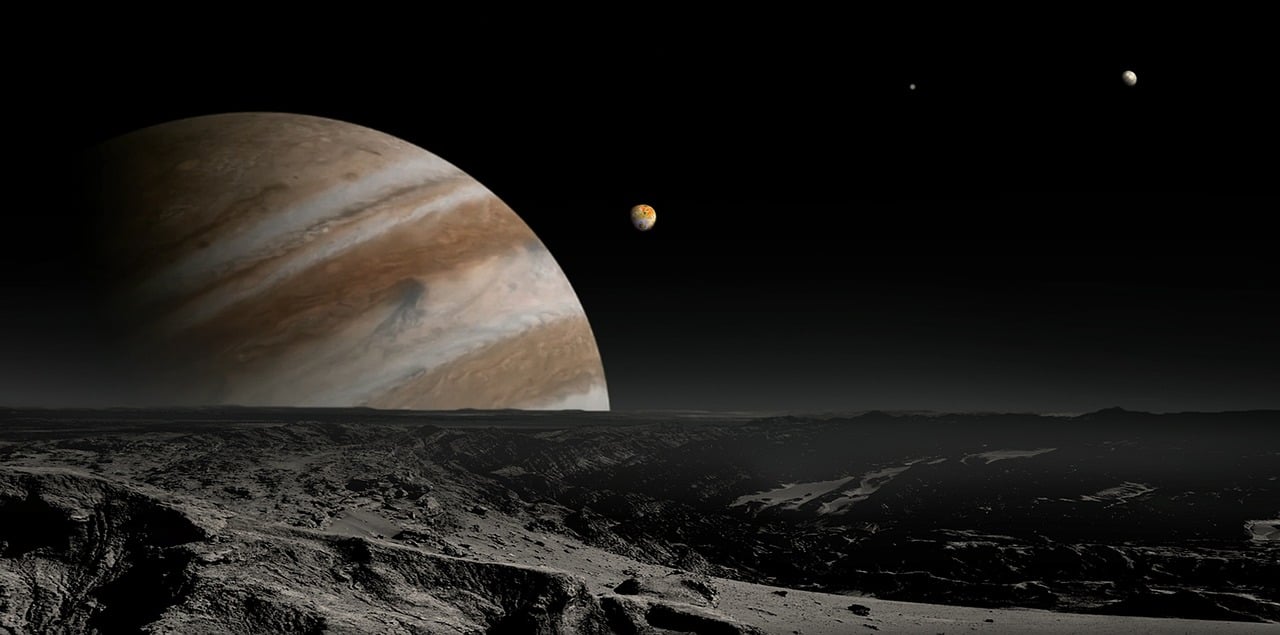
Introduction to Ganymede
Ganymede is the largest moon in our solar system and is an intriguing celestial body with many fascinating facts. As one of Jupiter’s moons, Ganymede has a diameter of about 5,268 kilometers (about 3273.38 mi), making it larger than the planet Mercury.
It is the only moon known to have its magnetic field, which is created by the interaction between its iron core and Jupiter’s powerful magnetic field. This magnetic field has been observed by spacecraft missions, providing valuable data about Ganymede’s internal structure and composition.
One of the most interesting facts about Ganymede is its unique geology. The moon has a varied surface, with both ancient and relatively young regions. Ancient terrains are heavily cratered, indicating that they have been around for billions of years.
On the other hand, the younger regions are marked by long, linear grooves called furrows, as well as ridges and valleys. These features suggest that Ganymede has experienced tectonic activity and possibly even internal heating in the past.
Another intriguing aspect of Ganymede is its potential for hosting liquid water. Scientists believe that beneath its icy crust, there may be a subsurface ocean of liquid water.
This hypothesis is supported by evidence from spacecraft observations, which have detected variations in Ganymede’s magnetic field that could be explained by the presence of a salty ocean.
If confirmed, this would make Ganymede one of the few places in our solar system, along with Jupiter’s moon Europa and Saturn’s moon Enceladus, where liquid water exists.
Ganymede also has a thin atmosphere composed mainly of oxygen. However, this atmosphere is extremely tenuous and does not support life as we know it. It is thought to be created by charged particles from Jupiter’s magnetosphere interacting with Ganymede’s surface.
Despite its thinness, studying Ganymede’s atmosphere can provide valuable insights into the moon’s interaction with its parent planet.
Size and Composition of Ganymede
Ganymede is the largest moon in our solar system and is even larger than the planet Mercury. It has a diameter of about 5,268 kilometers, making it larger than both the moons Europa and Io, which orbit Jupiter along with Ganymede.
In terms of composition, Ganymede is primarily composed of rock and ice. Its core is thought to be made up of molten iron, which generates a magnetic field.
Surrounding the core is a rocky mantle, and above that is a thick layer of ice. This layer of ice is estimated to be about 800 kilometers thick.
One interesting aspect of Ganymede’s composition is its surface. It is composed of two main types of terrain: dark, heavily cratered regions and lighter, grooved regions. The dark regions are believed to be older and have accumulated more impact craters over time.
The grooved regions, on the other hand, are thought to be much younger and are characterized by a network of ridges and valleys.
One example of the grooved terrain on Ganymede is the highly prominent feature called Galileo Regio.
It is a long, dark region that stretches across the moon’s surface and is marked by parallel grooves. These grooves are believed to have formed through tectonic activity, where the icy surface cracked and moved apart.
Another interesting feature of Ganymede is its magnetic field. It is the only moon in our solar system known to have its own magnetic field. This field is generated by the moon’s molten iron core, which creates a dynamo effect.
The magnetic field of Ganymede is believed to be connected to Jupiter’s magnetic field, giving rise to unique interactions between the two.
Ganymede’s Unique Features
Ganymede, the largest moon in the solar system, is a fascinating celestial body with several unique features that set it apart from other moons. Let’s explore some of these distinguishing characteristics.
1. Size and Composition
Ganymede is larger than the planet Mercury and even exceeds the size of the dwarf planet Pluto. With a diameter of approximately 5,268 kilometers, it is the largest moon in our solar system. Its size is comparable to that of some planets, making it an intriguing object of study.
2. Dual Nature
One of the most remarkable aspects of Ganymede is its dual nature. It is composed of both rock and ice, giving it a diverse and complex structure. Beneath its icy crust lies a rocky mantle and a molten iron core.
This unique composition sets Ganymede apart from other moons and makes it the only moon known to have its own magnetic field.
3. Surface Features
Ganymede’s surface is a mosaic of ancient and relatively young terrains. Its cratered regions, which resemble the Moon’s surface, indicate its early history of intense meteoroid impacts.
Additionally, Ganymede showcases a network of grooves and ridges that appear to be the result of tectonic activity. Such geological features make Ganymede a geologically dynamic moon.
4. Subsurface Ocean
Recent observations and studies have suggested the existence of a subsurface ocean beneath Ganymede’s icy crust.
The presence of this vast ocean, estimated to be around 100 kilometers in depth, opens up possibilities for the existence of liquid water and potential habitats for life. The exploration of this subsurface ocean could provide valuable insights into the potential for life beyond Earth.
5. Magnetosphere
Ganymede is unique among moons because it has its own magnetic field. This is believed to be generated by the interaction between its iron-rich core and the moon’s subsurface ocean.
Its magnetosphere is also influenced by the powerful magnetic field of Jupiter, the planet it orbits. This interaction creates a complex and intricate magnetic environment around Ganymede, offering scientists a wealth of information to study.
In summary, Ganymede stands out among other moons due to its impressive size, dual nature, diverse surface features, subsurface ocean, and its own magnetic field.
As our understanding of this intriguing moon continues to evolve, further exploration and research will undoubtedly reveal even more fascinating discoveries about Ganymede’s unique characteristics.
The Enigma of Water on Ganymede
The presence of water on Ganymede has been a topic of great interest and debate among scientists. While it was initially believed that Ganymede’s water existed solely in the form of ice, recent discoveries have challenged this notion.
Data collected by the Galileo spacecraft, which orbited Jupiter and its moons in the late 1990s, provided evidence of a subsurface ocean beneath Ganymede’s icy crust.
This discovery opened up a wealth of possibilities and prompted further investigation into the potential for life on this intriguing moon.
The subsurface ocean on Ganymede is believed to be in contact with the moon’s rocky core, creating a dynamic environment that could potentially support life.
The presence of liquid water, along with the necessary chemical ingredients and a source of energy, are key components for the development and sustenance of life as we know it.
Scientists are now actively studying Ganymede to understand the conditions within its subsurface ocean and to assess the potential for habitability.
Past Missions to Ganymede
Ganymede, the largest moon in our solar system, has been the subject of several past missions that aimed to study its unique characteristics and unlock the secrets it holds. These missions have provided valuable insights into the moon’s geology, atmosphere, and potential for habitability.
One notable mission was the Galileo spacecraft, which was launched by NASA in 1989. Galileo performed several flybys of Ganymede, providing detailed images and data about its surface and icy crust.
The mission revealed a complex and geologically active world, with evidence of tectonic activity and a diverse range of terrain features.
Another mission that explored Ganymede was the European Space Agency’s (ESA) Jupiter Icy moons Explorer (JUICE) mission. Scheduled for launch in 2022, JUICE aims to study Jupiter and its moons, with a focus on Ganymede.
The mission plans to conduct detailed observations of the moon’s surface, subsurface, and magnetosphere, shedding light on its geological and evolutionary history.
In addition to these dedicated missions, other spacecraft, like the Voyager and the Hubble Space Telescope, have also gathered valuable data on Ganymede during their journeys through the solar system.
These observations have provided valuable insights into the moon’s composition, magnetic field, and the presence of water.
The study of Ganymede is of great interest to scientists because of its potential for hosting life. It is believed that beneath its icy crust lies a subsurface ocean, making it a prime target in the search for extraterrestrial life.
By studying the moon’s geological processes, its magnetic interactions with Jupiter, and the potential for organic compounds, scientists hope to gain a better understanding of the conditions necessary for life to thrive.
Recent Discoveries and Evidence of Water
Recent discoveries and evidence have provided substantial support for the presence of water on other celestial bodies in our solar system and beyond.
These findings have not only expanded our understanding of the potential for life beyond Earth but also opened up new avenues for exploration and scientific research.
One of the most significant discoveries came from NASA’s Mars Exploration Rover mission, which has been exploring the red planet since 2004. The rovers, Spirit and Opportunity, have provided compelling evidence of past water activity on Mars.
They have analyzed rock formations and found minerals that could only have formed in the presence of water. Additionally, Curiosity, the most recent rover to land on Mars, has discovered an ancient riverbed, further confirming the presence of liquid water in Mars’ past.
Another noteworthy example is the discovery of plumes erupting from the icy moon Enceladus, one of Saturn’s moons. NASA’s Cassini spacecraft detected the plumes, which contained water vapor, ice particles, and organic molecules.
This finding suggests that Enceladus has a subsurface ocean, raising the possibility of habitable environments beyond Earth.
Similarly, Jupiter’s moon Europa has also shown evidence of a subsurface ocean. Observations from the Hubble Space Telescope revealed plumes of water vapor erupting from Europa’s surface.
These findings have sparked excitement among scientists, as Europa’s ocean may harbor conditions suitable for life.
Beyond our solar system, astronomers have detected water vapor in the atmospheres of exoplanets.
For example, the study of exoplanet K2-18b, located 110 light-years away, has revealed the presence of water vapor.
This exoplanet is within the habitable zone of its star, making it a promising candidate in the search for extraterrestrial life.
These discoveries and evidence of water on various celestial bodies emphasize the importance of water in the search for life beyond Earth.
Water is a crucial ingredient for life as we know it, and its presence in various forms across the universe increases the likelihood of finding habitable environments and potentially even extraterrestrial life.
In conclusion, recent discoveries and evidence have shown that water is not exclusive to Earth but exists in various forms on other celestial bodies.
These findings have not only expanded our knowledge of the universe but also raised intriguing possibilities for the existence of life beyond our planet.
The Potential for Life on Ganymede
Ganymede, one of Jupiter’s moons, has long fascinated scientists with its potential for supporting life. As the largest moon in our solar system, Ganymede boasts a unique set of characteristics that make it an intriguing candidate for harboring life.
One of the most significant facts about Ganymede is its subsurface ocean, which is believed to contain more water than all of Earth’s oceans combined. This vast amount of liquid water raises the possibility of Ganymede hosting some form of life, as water is a key ingredient for life as we know it.
Furthermore, Ganymede’s subsurface ocean is thought to be in contact with a rocky seafloor, providing the necessary chemical ingredients for life to thrive. The presence of rocky material and an energy source, such as heat generated by tidal forces from Jupiter’s gravitational pull, could create a suitable environment for microorganisms to flourish.
Scientists speculate that Ganymede’s subsurface ocean may contain hydrothermal vents, similar to those found on Earth’s ocean floors, which are known to support diverse ecosystems.
Additionally, Ganymede’s surface features provide further evidence for its potential habitability. The moon’s geological activity, including tectonic motion and cryovolcanism, suggests a dynamic environment that could support life.
The presence of these geological processes indicates the possibility of nutrient cycling and other essential conditions for life’s sustenance.
Although Ganymede’s icy surface poses a challenge for direct exploration, several missions have been proposed to study this intriguing moon in greater detail. These missions would aim to investigate Ganymede’s subsurface ocean and search for signs of life.
By analyzing the composition of its water and studying any potential organic molecules, scientists hope to gain valuable insights into Ganymede’s habitability.
Frequently Asked Questions
Is Ganymede a moon of Jupiter?
Yes, Ganymede is the largest moon of Jupiter and the largest moon in our solar system. It was discovered by Italian astronomer Galileo Galilei in 1610 along with three other large moons of Jupiter.
Does Ganymede have water?
Yes, Ganymede is believed to have a significant amount of water. It is thought to have a subsurface ocean beneath its icy crust. This subsurface ocean is considered one of the largest water oceans in the solar system and is a subject of scientific interest for potential habitability.
How was the evidence of water on Ganymede discovered?
Evidence of water on Ganymede was discovered through observations made by spacecraft, including NASA’s Galileo mission. These observations indicated that Ganymede has a magnetic field, and the way this magnetic field interacts with Jupiter’s magnetic field suggests the presence of a subsurface, liquid saltwater ocean.
Could there be life in Ganymede’s subsurface ocean?
While the presence of water is a key ingredient for the possibility of life, other factors like temperature, chemical composition, and energy sources also play crucial roles. Ganymede’s subsurface ocean is extremely cold, and any potential life forms would face significant challenges. Further research is needed to determine if life could exist there.
What makes Ganymede’s subsurface ocean significant?
Ganymede’s subsurface ocean is significant because it represents an intriguing possibility for extraterrestrial oceans. Studying Ganymede’s Ocean can provide insights into the potential habitability of icy moons and planets in our solar system and beyond. It also raises questions about the diversity of environments where life could exist in the universe.
Conclusion
Ganymede, with its immense size, unique features, and potential for water and life, has proven to be a celestial enigma. Its exploration has provided valuable data and insights into the mysteries of our solar system and the potential for habitable environments beyond Earth.
Ganymede’s subsurface ocean and its potential for harboring life make it a prime target for future exploration.
As we continue to unravel the secrets of Ganymede, our understanding of the universe and the possibilities it holds for life will expand. The search for water and life beyond Earth is an ongoing quest that drives scientific exploration and pushes the boundaries of our knowledge.
Ganymede, with its fascinating truths and enigmatic nature, serves as a reminder of the vastness and complexity of the cosmos, sparking our curiosity and inspiring us to reach for the stars.




Discussion about this post