What are Gravitons?
Gravitons have captivated the minds of scientists for decades. As we delve into the depths of particle physics, we encounter a fundamental question: Do gravitons truly exist, or are they merely a theoretical construct?
Unraveling the mystery of gravitons holds profound implications for our understanding of the universe and could revolutionize our grasp of gravity’s intricacies.
By exploring the existence and properties of gravitons, it will help us comprehend the fundamental nature of gravity itself, illuminating new vistas in physics and cosmology.
It is said that gravitons are hypothetical particles postulated to be carriers of the gravitational force, much like photons carry the electromagnetic force.
Characteristics of Gravitons
The expected characteristics of gravitons include masslessness, propagation at the speed of light, and a spin-2 boson nature. This spin arises from the source of gravitation being the stress-energy tensor, a second-order tensor.
Remarkably, any massless spin-2 field would produce a force indistinguishable from gravity, indicating that a massless spin-2 particle discovered would likely be the graviton.
Relation to Gravity
Gravitons, though they may evoke thoughts of fictional characters like Graviton from the Marvel Universe, have a significant role in theoretical physics.
In the realm of quantum field theory, gravitons are the fundamental particles responsible for mediating gravitational force.
In simpler terms, when you observe an object being pulled back down to Earth after being thrown upwards, it is the work of gravitons exerting the force of gravitation.
Potential in String Theory
Although there is no complete quantum field theory for gravitons due to mathematical challenges in general relativity’s renormalization, string theory offers a potential framework where gravitons emerge as massless states of fundamental strings.
The quest for evidence of gravitons continues, driven by the desire to unify quantum mechanics and general relativity while unraveling the mysteries of gravity’s fundamental nature.
History
The concept of gravitons remains an active area of research, with scientists exploring their properties and implications within various theoretical frameworks.
The Birth of Gravitons
The term “graviton” was introduced to describe particles that were anticipated to mediate the gravitational force, similar to how photons mediate the electromagnetic force.
Gravitons were first proposed by Soviet physicists Dmitrii Blokhintsev and F.M. Gal’perin in 1934.
However, these early conceptions of gravitons were different from the modern understanding and were not connected to quantum mechanics or special relativity.
Gravitational Theory
Apart from the gravitational force, three primary forces exist in nature, each mediated by their respective elementary particles.
Photons carry the force of electromagnetism, W and Z bosons mediate the weak interaction, and gluons are responsible for the strong nuclear force.
These microscopic particles play a crucial role in conveying the forces observed at macro levels. The search for an elementary particle mediating the gravitational force led to the concept of gravitons.
Theoretical Existence vs. Experimental Proof
While gravitons are theorized as the elementary particles mediating gravitational force, experimental proof of their existence remains elusive.
The lack of a physically feasible detector poses a significant obstacle to their detection.
The weakness of gravitational force makes it physically implausible to detect gravitons due to their infinitesimally small cross-section of interaction with matter.
Related articles here:
Certainties and Attributes
Despite the detection challenges, scientists have gained certain insights into gravitons. The gravitational force exists between any two particles, regardless of their relative positions.
Consequently, the particles mediating this force must be massless. Moreover, since the source of gravitation is the stress-energy tensor, which is a second-order tensor, the mediating particles must carry a spin of 2.
These characteristics indicate that the detection of a massless particle with a spin of 2 would likely be a graviton.
Challenges in Describing Graviton Interactions
When it comes to describing interactions involving gravitons, classical theories like Feynman diagrams work well, but problems arise with more complex diagrams.
These difficulties arise because quantized general relativity, unlike quantum electrodynamics, is not perturbatively renormalizable.
As a result, the theory loses predictive accuracy, and physicists struggle to calculate certain probabilities related to graviton emission and absorption.
A Mindblowing Subject
In the realm of physics, the nature of gravity has always been a fascinating subject.
Over the years, various theories have been proposed to explain this fundamental force that governs the behavior of objects in the universe.
One intriguing concept is the existence of gravitons, hypothetical subatomic particles that are believed to transmit the force of gravity.
Classical Mechanics and General Relativity
To comprehend the concept of gravitons, it is crucial to start with a foundation in classical mechanics.
Sir Isaac Newton’s Newtonian theory of gravity suggests that the force of gravity arises from the gravitational attraction between two objects.
However, this classical view of gravity was revolutionized by Albert Einstein’s theory of general relativity.
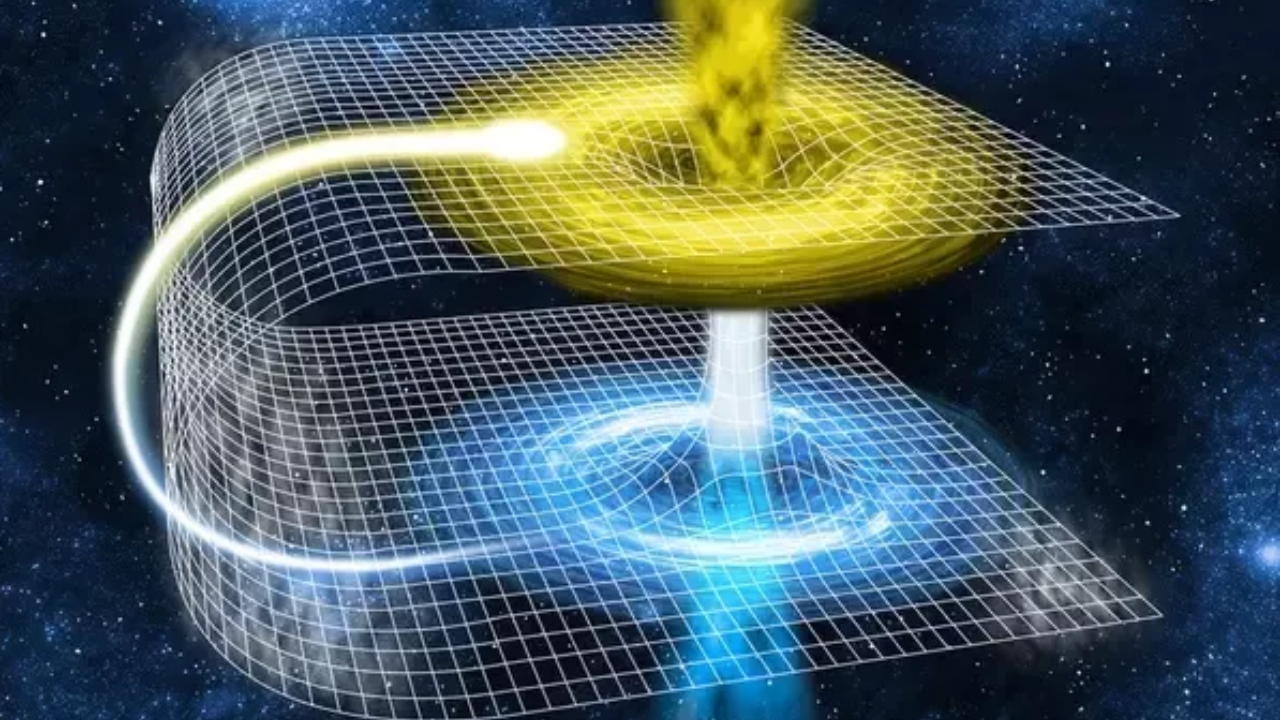
According to general relativity, gravity is the result of the curvature of space and time caused by the presence of mass and energy.
This theory intertwined space and time into a single entity called space-time, suggesting that the distortion of space-time gives rise to the gravitational force we observe.
The Quantum Mechanical Conundrum
While classical mechanics provides a satisfactory explanation for gravity on a macroscopic scale, it fails to account for the microscopic realm governed by quantum mechanics.
This disconnect led to the emergence of the graviton theory in the 1930s, proposed by two Russian physicists.
Drawing parallels to the way the electromagnetic force is transmitted through the exchange of particles called photons, they postulated that gravity could be transmitted by a hypothetical subatomic particle called the graviton.
String Theory and Gravitons
The graviton finds its roots in another controversial theory called string theory.
String theory suggests that all matter in the universe is composed of tiny vibrating one-dimensional entities known as strings.
These strings are categorized into open and closed strings. Open strings are believed to constitute the matter we are familiar with, permanently attached to our universe referred to as a brane.
On the other hand, closed strings, which include gravitons, are not bound to our universe and can potentially travel to other universes or branes if they exist.
The Challenge of Detection
One of the significant hurdles in unraveling the mysteries of gravitons lies in their detection.
Since gravitons are theorized to be closed strings, they are not bound to our universe or brane, making their detection a formidable task.
Detecting gravitons originating from other universes or branes would provide valuable evidence of their existence.
However, the existence of other universes remains speculative, and even if they do exist, the vast distances between them pose significant challenges.
Gravitons are estimated to travel at the speed of light, but the immense cosmic distances make their detection a daunting endeavor.
The Weakness of Gravity
Contrary to popular belief, gravity is one of the weakest forces in nature.
For instance, the bonds holding together a hydrogen atom are stronger than the gravitational force it experiences.
This inherent weakness of gravity is attributed to the feeble interaction of gravitons. Gravitons interact very weakly, making their detection even more challenging.
The elusive nature of gravitons presents a significant obstacle in confirming their existence experimentally.
The Quest for Gravitons
Although gravitons remain theoretical entities, they provide a fascinating framework for understanding gravity.
The theory of gravitons offers a starting point for scientists to explore the complexities of gravity beyond the realm of general relativity.
Researchers, such as those at Fermilab, are eagerly searching for evidence of gravitons, hoping to confirm their existence and shed further light on the nature of gravity.
Until then, gravitons remain a tantalizing concept waiting to be discovered.
The Existence of Gravitational Waves
Gravitational waves are disturbances in the gravitational field caused by significant events, such as the collision of stars or the interaction of massive objects.
While we have not directly detected gravitons or gravitational waves, scientists are working diligently to observe them.
The Laser Interferometric Gravitational-Wave Observatory (LIGO) is a groundbreaking project employing advanced laser interferometry techniques to detect and measure the slight changes in space caused by gravitational waves.
The Nobel Laureates’ Contributions
The groundbreaking work of scientists like Joe Taylor and Russell Hulse, who received the Nobel Prize in Physics for their research on binary pulsars, has brought us closer to understanding gravity and its potential connection to gravitons.
Their discoveries have provided indirect evidence of gravitational energy and shed light on the behavior of massive objects in space.
Such achievements serve as a testament to the ongoing pursuit of scientific knowledge and the mysteries that remain.
Fundamental Interactions and Particle Mediation
Physicists recognize four fundamental interactions: electromagnetism, the strong interaction, the weak interaction, and gravity.
The three former interactions are mediated by specific particles, such as photons for electromagnetism and gluons for the strong interaction.
Hence, it is logical to assume that gravity, as a fundamental interaction, should also have a mediator particle. This expectation stems from the consistency in the framework of fundamental interactions.
The Equation of Gravitational Waves
To understand why the detection of gravitational waves supports the existence of gravitons, it is crucial to examine the equation governing these waves.
The equation, derived from the weak field approximation of general relativity, is a spin-2 field equation.
This indicates that the equation encapsulates the behavior of particles with a spin of 2, which corresponds to the characteristics of gravitons.
Thus, the equation implies the existence of gravitons as the carriers of the gravitational wave.
Support from Quantum Gravity Formulations
Serious formulations of quantum gravity, which aim to unify quantum mechanics and general relativity, consistently support the existence of gravitons.
These formulations provide a theoretical framework where gravitons play a fundamental role in understanding gravity at a quantum level.
The gravitational waves and their behavior, as predicted by these formulations, align with the properties expected from the existence of gravitons.
Frequently Asked Questions
Could gravitons help us understand the mysteries of the universe?
Gravitons represent a potential key to unraveling the mysteries of gravity and its fundamental nature. Further research into gravitons and their properties could enhance our understanding of quantum gravity, the behavior of black holes, the early universe, and the ultimate goal of unifying all fundamental forces.
Can gravitons explain the behavior of black holes?
Gravitons are believed to play a role in the behavior of black holes, particularly in the context of quantum gravity. Understanding the interaction of gravitons within the extreme conditions near black holes could provide insights into phenomena such as Hawking radiation and the information paradox.
Do we really need to study gravitons?
Studying gravitons is essential for advancing our understanding of fundamental physics, particularly in the context of unifying quantum mechanics and general relativity. While gravitons have not been directly detected yet, their theoretical existence holds significant implications for the nature of gravity and the fundamental forces governing the universe.
Takeaway
The quest to understand the intricacies of gravity has led scientists to explore the concept of gravitons, hypothetical subatomic particles that could be responsible for transmitting the force of gravity.
While classical mechanics and general relativity provide explanations for gravity on macroscopic scales, the emergence of quantum mechanics demands a deeper understanding of gravity on a microscopic level.
Gravitons, if proven to exist, could bridge this gap, allowing scientists to unravel the mysteries of gravity at its fundamental level.
However, the weak interaction of gravitons and the challenges associated with their detection continue to make their existence a subject of ongoing exploration and investigation.
As scientific advancements continue, the quest for gravitons and a deeper understanding of gravity promises to be an exciting journey filled with discoveries and revelations.
If you found this article informative, consider subscribing to our YouTube channel for more mind-blowing and thought-provoking content.
More articles here:




Discussion about this post