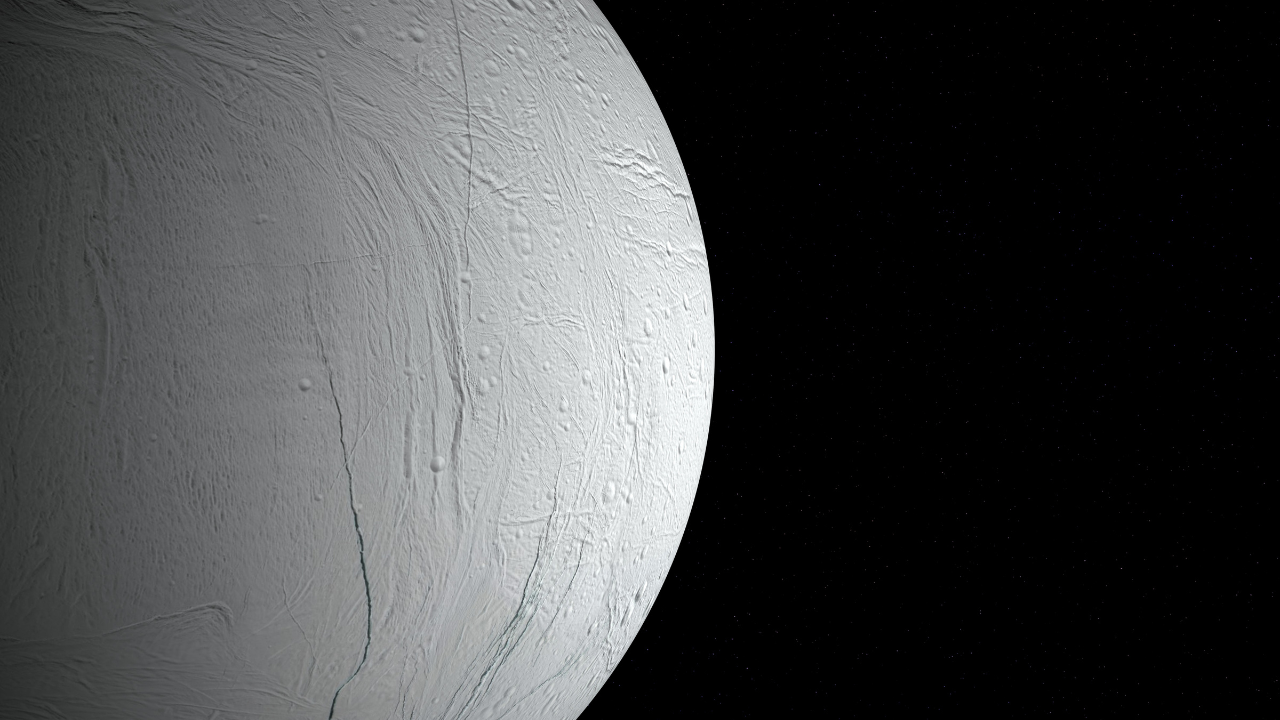
Unveiling Enceladus: Unearthing Clues to Extraterrestrial Life
There is something more to Enceladus, one of Saturn’s largest and most captivating moons, than its icy facade. It also lies a celestial wonder, offering a captivating spectacle that has fascinated scientists and space enthusiasts alike.
Beneath its frozen surface, Enceladus conceals a hidden treasure – a subsurface ocean of liquid water, an incredibly rare find in our solar system. This article will delve into the mysteries of this remarkable moon, unlocking the secrets of its icy plumes and the potential for life beyond our home planet.
Discover the allure of Enceladus, a celestial jewel that beckons us to explore its depths and unravel the enigmas it holds.
Enceladus: Saturn’s Enigmatic Moon
Enceladus, Saturn’s second nearest major regular moon and the brightest among its lunar companions, was first discovered in 1789 by the renowned English astronomer William Herschel. Its name pays homage to one of the Giants (Gigantes) from Greek mythology.
Key Features
With a diameter of approximately 500 km (310 miles), Enceladus gracefully orbits Saturn in a prograde, nearly circular path, positioned at an average distance of 238,020 km (147,899 miles) from its host planet. Its intriguing features have captured the curiosity of scientists and astronomers.
The moon’s relatively low average density, being only 60 percent greater than that of water, suggests the presence of significant non-ice materials within its interior. Enceladus boasts a surface that reflects almost all the light that strikes it, in stark contrast to Earth’s Moon, which reflects about 7 percent.
The surface itself appears predominantly smooth, adorned with cratered and grooved plains, composed mainly of pristine water ice, with subtle traces of carbon dioxide, ammonia, and light hydrocarbons.
Enceladus stands as a testament to the wonders concealed within Saturn’s cosmic realm, beckoning us to unearth more of its hidden enigmas and unravel the secrets of our solar system’s icy moons.
Related articles:
The Mysterious Rings of Saturn: What are They Made of, and How Do They Work?
Planets of Rings – What Planets Have Rings?
More Astonishing Discoveries
Until the momentous flyby of the U.S. spacecraft Voyager 2 in 1981, Enceladus remained shrouded in mystery. The spacecraft’s close proximity of 87,000 km (54,000 miles) brought to light a moon of incredible geological complexity, with its surface having undergone five distinct evolutionary periods.
A Close Encounter
Subsequent observations by the Cassini spacecraft, commencing in 2005, added even more depth to our understanding of Enceladus. A series of close flybys, including one within 50 km (30 miles) in 2008, unveiled the moon’s current geological activity.
High heat flow and eruptions of water vapor and ice plumes, akin to cryovolcanism, emerged prominently in its south polar region. The source of this activity?
Four principal ridges, aptly named “tiger stripes,” believed to be tectonic fractures surrounded by fields of ice boulders. The awe-inspiring plume structures extended over 4,000 km (2,500 miles) from Enceladus’s surface, hinting at a world teeming with surprises.
Temperatures in Enceladus’s active regions were unexpectedly higher than anticipated, reaching at least −93 °C (−135 °F) compared to the projected −200 °C (−328 °F). The plumes’ jets originated from specific hot regions along the tiger stripes.
Intriguingly, relatively craterless areas on the moon, aged at about 100 million years, suggested recent geological melting and refreezing, raising questions about multiple active regions throughout Enceladus’s history.
Enceladus’s 33-hour orbit around Saturn is associated with the more distant moon Dione in an orbital resonance. This intriguing phenomenon could lead to significant tidal heating within the involved moons, although further detailed calculations are necessary to comprehend its full impact on Enceladus’s continuous activity.
Role in Creating Saturn’s Ring
Enceladus’s ongoing activity played a remarkable role in creating Saturn’s E ring, a faint ring composed of micrometer-sized water ice particles condensed from the erupting vapors.
This ring, far-reaching and extending beyond Saturn’s other known moon, Rhea and its orbit, continuously replenishes its particles through cryovolcanic eruptions. It results in the moon and other major inner moons of Saturn exuding a bright appearance.
Presence of Liquid Water Beneath Its Icy Crust
Many models propose that Enceladus’s activity is sustained by liquid water beneath its icy crust. Compelling evidence, including the high-speed particles in the plumes and the presence of sodium, supports the idea of liquid water at the base of the jets.
Measurements of Enceladus’s rotation reveal an ocean underneath its surface, enveloping the entire globe. Analysis of ejected silicate dust grains points to the intriguing possibility of hydrothermal vents at the ocean’s bottom, where water may be heated by much hotter rocky material.
Enceladus, Saturn’s captivating moon, continually surprises us with its geological richness and potential for harboring liquid water—a cosmic gem that keeps researchers and dreamers captivated, ever eager to unlock its secrets.
Can Enceladus Harbor Life?
Could Enceladus, Saturn’s enigmatic moon, harbor the building blocks of life?
Recent findings suggest that this small moon, with its subsurface ocean and intriguing geysers, might indeed have the potential to support life as we know it.
At the heart of this discovery lies the role of phosphorus, a critical chemical element for many biological processes.
Phosphorus on Enceladus
In a groundbreaking study, an international team of scientists leveraged data collected by NASA’s Cassini mission to unearth a startling revelation.
Enceladus, already known for its subsurface ocean that periodically erupts through fissures in its icy crust, was found to contain phosphorus within salt-rich ice grains that are expelled into space. This discovery holds immense significance because phosphorus is a fundamental ingredient for the existence of life.
Phosphorus: The Crucial Element for Life
Phosphorus, often regarded as one of the essential elements for biological processes, plays a pivotal role in life as we know it.
It forms a foundational component of DNA, which carries genetic information, and is present in various vital structures, including cell membranes, bones, and energy-carrying molecules. Without phosphorus, life as we understand it would not be possible.
Frank Postberg, a planetary scientist at Freie Universität Berlin, Germany, led the study that revealed the presence of phosphorus salts within icy particles ejected from Enceladus’ plumes.
This groundbreaking observation marks the first time that this essential element has been identified in an extraterrestrial ocean.
Enceladus’ Icy Grains
Previous analyses of Enceladus’ ice grains had revealed the presence of sodium, potassium, chlorine, and carbonate-containing compounds.
These compounds, combined with the newly discovered phosphorus, create a chemical orchestra that hints at the moon’s potential for hosting life.
This discovery extends beyond Enceladus alone. Laboratory experiments conducted by co-authors in Europe and Japan indicated that Enceladus’ ocean holds concentrations of phosphorus-bound water-soluble forms of phosphate.
These concentrations exceed those found in Earth’s oceans by at least a hundredfold. Furthermore, geochemical modeling suggests that icy ocean worlds throughout the outer solar system could also harbor high levels of phosphate, particularly those with access to liquid water and rocks.
Possibilities and Uncertainties
While the presence of phosphorus on Enceladus raises hopes for the potential habitability of its ocean, it’s important to note that the mere existence of the necessary ingredients does not guarantee the presence of life.
Christopher Glein, a planetary scientist and geochemist at Southwest Research Institute, emphasizes that while having the ingredients is a crucial step, other factors must align for an extraterrestrial environment to foster life.
Although Cassini’s mission concluded in 2017 with its dramatic plunge into Saturn’s atmosphere, its legacy endures. The mission, originally designed to explore Saturn, its rings, and moons, unearthed discoveries that continue to reverberate far beyond the realm of planetary science.
While the discovery of phosphorus on Enceladus marks a significant stride in our understanding of potential extraterrestrial habitats, the mystery of life beyond our home planet remains an open question, awaiting further exploration and discovery.
Presence of Methane
Meanwhile, recent research also suggests that the presence of methane emanating from this distant world might provide the key to extraterrestrial life.
Geysers erupting from “tiger stripe” fractures near Enceladus’ south pole were seen propelling particles of water ice into space. These icy particles formed a plume that feeds Saturn’s E ring, revealing the presence of a vast ocean of liquid water beneath Enceladus’ icy exterior.
But the plume holds more secrets than just water ice. Cassini’s close encounters with the 313-mile-wide moon revealed a medley of compounds, including dihydrogen (H2) and various carbon-containing organic compounds, notably methane (CH4).
The presence of dihydrogen and methane has particularly captured the attention of astrobiologists. Scientists theorize that Enceladus’ H2 may result from interactions between rock and heated water on its seafloor, possibly indicating deep-sea hydrothermal vents—a setting reminiscent of Earth’s potential cradle of life.
Methane, on the other hand, is associated with Earthly microbes that convert dihydrogen and carbon dioxide into energy—a process known as methanogenesis. Could Enceladus host similar methane-producing microbes?
The Encouraging Revelation and Its Implications
The study unveils an encouraging possibility—abiotic hydrothermal-vent chemistry, a process occurring without the involvement of life, does not entirely explain the observed methane concentrations detected by Cassini. However, when considering the contributions of methanogenic microbes, the puzzle pieces align more seamlessly.
Yet, it’s crucial to emphasize that the study does not assert the existence of life on Enceladus. The researchers propose alternative hypotheses, such as non-biological methane production mechanisms rooted in the moon’s unique conditions.
While the notion of life on Enceladus remains unproven, biological methanogenesis is an intriguing possibility supported by the data. The path forward involves gathering more data from upcoming missions to either strengthen or refute the life hypothesis.
In the quest to decipher Enceladus’ mysteries, the role of methane emerges as a potential beacon guiding us toward a deeper understanding of the moon’s potential for hosting life.
Could There Also Be Life on Saturn’s Other Moons?
Saturn’s cosmic neighborhood is home to a diverse cast of moons, each offering a unique perspective on the potential for life beyond our planet. While Enceladus has tantalized us with its subsurface ocean and methane clues, other moons like Titan also hold captivating mysteries.
Titan: A World of Its Own
Titan, Saturn’s largest moon, is a celestial wonder that beckons us to uncover its secrets. Its thick atmosphere, even denser than Earth’s, shrouds the moon in an enigmatic veil.
Composed mainly of nitrogen and methane, Titan’s atmosphere plays host to a symphony of organic compounds. These molecules, born from sunlight’s dance with methane, cascade down to its surface like cosmic rain.
Titan is a realm of constant change, where powerful winds orchestrate dust storms and icy volcanoes dot its landscape. Strangely, its sand defies Earth’s conventions, sticking together in peculiar clumps.
But the cold grip of Titan is unyielding, with temperatures plummeting to a bone-chilling –180°C. Its rivers and lakes, though not brimming with water, cradle an oily embrace—a mix of methane and ethane.
NASA dares to dream of crafting a submarine to plunge into these hydrocarbon realms, unveiling Titan’s enigmatic depths.
As we delve into the cosmos, our quest for life extends beyond traditional boundaries. While Enceladus remains a beacon of potential, Saturn’s other moons, like Titan, whisper tales of alternate possibilities—ushering us to broaden our horizons and imagine life forms that dance to a different cosmic rhythm.
Frequently Asked Questions
What are the other moons of Saturn?
Saturn boasts an impressive 146 moons. Leading this lunar parade is Titan, nearly Mars-sized, discovered by Christiaan Huygens in 1655. Alongside Enceladus, notable Saturnian moons encompass Titan, Rhea, Iapetus, Dione, and Mimas, showcasing the planet’s celestial entourage.
How was Enceladus discovered?
Enceladus emerged through the lens of discovery on August 28, 1789, when William Herschel unveiled its presence. His pioneering gaze pierced the cosmos using a groundbreaking telescope, a colossal innovation of its time, at Observatory House in Slough, England.
What kind of telescopes do ancient astronomers like William Herschel use?
Ancient astronomer William Herschel employed the Great Forty-Foot telescope, a reflective marvel born between 1785 and 1789 at Observatory House, Slough, England. This instrument showcased a 48-inch (120 cm) primary mirror, boasting a lengthy 40-foot (12 m) focal length, thus earning its moniker “Forty-Foot.”
Takeaway
In the heart of Enceladus, Saturn’s alluring moon, lies a secret beyond its icy visage. Beyond the frosty façade, a cosmic marvel beckons, captivating scientists and dreamers alike.
Concealed beneath the frozen crust rests a precious gem – a clandestine ocean of liquid water, a rarity within our solar tapestry. As we conclude this exploration, Enceladus’s potential signs of life echo, igniting a fervor for further investigation.
Its enigmatic allure, coupled with the tantalizing prospect of life, fuels our yearning to decode its mysteries. The implications are profound, as Enceladus reshapes the boundaries of possibility and kindles our cosmic curiosity.
More articles:
Eye Catching Discoveries in Planets
What are the Planet Sizes? – Planets in Order of Size
The Solar System Formation and the Earth Revolution




Discussion about this post