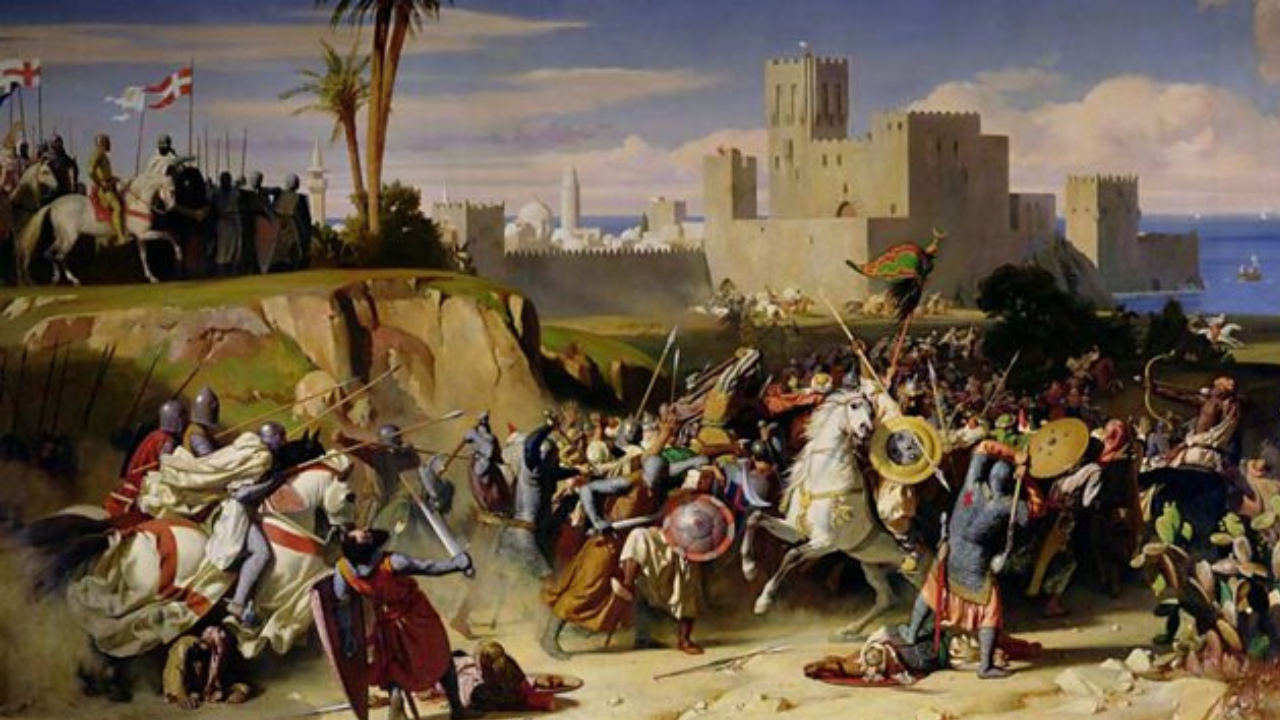
The English Crusade: Assessing the Justification and Its Significant Impacts
The English Crusade, a pivotal chapter in medieval history, unfolds as a remarkable fusion of religious fervor, political ambition, and cultural exchange. Spanning from the late 12th to early 13th century, it witnessed fervent expeditions to the Holy Land, inspired by religious zeal and calls for reclamation.
Marked by key events such as Richard the Lionheart’s renowned involvement, the Third Crusade, and the tragic clash at the Battle of Arsuf, the English Crusade embodies the confluence of spiritual devotion and geopolitical maneuvering.
This multifaceted campaign’s legacy resonates through time, exemplifying the intricate interplay between faith, power, and the quest for dominion, making it an enduring subject of historical inquiry. Here’s what we need to know about the English Crusade.
The English Crusade: A Series of Holy Wars
The English Crusade, an integral facet of the broader Crusades, encapsulated a sequence of fervent religious conflicts between Christians and Muslims, primarily aimed at securing dominion over revered holy sites.
Spanning from 1096 to 1291, this series of eight major Crusade expeditions showcased varying scales, strengths, and outcomes. Europe’s ascension as a significant power converged with the Byzantine Empire’s plea for aid against the Seljuk Turks, catalyzing a historical confluence.
Origins and Background
By the late 11th century, Western Europe had begun asserting itself as a formidable entity, juxtaposed with the Byzantine and Islamic Empires.
Who are the Seljuk Turks?
The Byzantine Empire’s losses to the Seljuk Turks galvanized Emperor Alexius I to seek assistance from the West, ultimately fostering improved relations between Eastern and Western Christians.
The Seljuq, sometimes spelled as Seljuk, were a powerful ruling family from the Oğuz Turkic tribes. They invaded southwestern Asia in the 11th century and established an empire that covered regions like Mesopotamia, Syria, Palestine, and much of Iran. This marked the start of Turkic influence in the Middle East.
Reclamation of the Holy Land
In 1095, Pope Urban II issued a clarion call for Western Christians to join forces, aiding the Byzantines and reclaiming the Holy Land from Muslim control.
This epochal declaration, delivered at the Council of Clermont, marked the inception of the Crusades. The response was resounding, uniting both nobility and commoners, all adorning the cross as a symbol of their commitment to the cause.
The English Crusade laid the foundation for several iconic religious knightly orders, such as the Knights Templar, the Teutonic Knights, and the Hospitallers. These stalwart groups championed the defense of the Holy Land and safeguarded Christian pilgrims journeying to and from the region, leaving an indelible mark on the era’s legacy.
Children’s Crusade
Within the annals of the Crusades, a lesser-known episode emerges—the Children’s Crusade of 1212. This poignant movement saw an eclectic assembly of individuals, including children, women, and the elderly, journeying from the Rhineland to Italy.
Guided by a young visionary named Nicholas, this unconventional endeavor underscored the fervor and unpredictability that characterized this tumultuous period.
Nonetheless, the English Crusade, among the mosaic of Crusades, holds a poignant significance, bridging faith, politics, and warfare in a tapestry that continues to captivate historians and enthusiasts alike.
Related articles:
The English Crusade’s First Crusade (1096-1099)
The opening act of the English Crusade saw the assembly of four distinct armies, drawing soldiers from various corners of Western Europe. Commanded by notable figures such as Raymond of Saint-Gilles, Godfrey of Bouillon, Hugh of Vermandois, and Bohemond of Taranto accompanied by his nephew Tancred, these military contingents embarked on their journey to Byzantium in the fateful year of 1096.
People’s Crusade under Peter the Hermit
Alongside these structured forces, an unorganized group, often referred to as the “People’s Crusade,” ventured forth under the charismatic guidance of the eloquent preacher Peter the Hermit, adding an element of spontaneity to the unfolding narrative.
Who is Peter the Hermit?
The emergence of Peter the Hermit’s band as a separate entity demonstrated the diverse motivations and levels of preparation present among those who answered the call to crusade.
Peter the Hermit, also known as Pierre l’Ermite, was a significant preacher during the First Crusade. He co-led the People’s Crusade alongside Walter Sansavoir, arriving in the East before the main Crusader armies.
After visiting the Holy Land around 1093, he passionately preached for the Crusade’s cause, rallying followers from France to Constantinople. However, his undisciplined army suffered losses, and he sought aid from the Byzantine emperor.
Ignoring Emperor Alexius I’s counsel to await the main force, Peter’s faction embarked on their own route, encountering swift defeat at the hands of Turkish forces at Cibotus.
Despite setbacks, he joined later Crusader expeditions across Anatolia. In Jerusalem, he played a role as the almoner of the Christian army and led processions before returning to Europe and establishing the Neufmoustier monastery.
Simultaneously, the ill-fated actions of Count Emicho and his followers, who carried out a series of violent massacres against Jewish communities in various Rhineland towns, cast a somber pall over the endeavor, generating widespread outrage and undermining Jewish-Christian relations.
Diplomacy and Alliances in Constantinople
The convergence of the main Crusader armies in Constantinople marked a crucial juncture. Here, they encountered the diplomatic maneuvering of Emperor Alexius I, who stipulated an oath of allegiance from their leaders, aimed at securing his authority over regained and newly conquered territories.
Although most leaders acceded to this demand, Bohemond’s resistance underscored the intricate web of alliances and interests at play. The subsequent military efforts, culminating in the capture of the Anatolian city of Nicea in June 1097, illustrated the dynamic interplay between faith, politics, and martial prowess.
From Antioch to Jerusalem
The Crusaders’ triumph in Nicea emboldened their resolve as they pressed forward. Capturing the strategic city of Antioch, albeit through internal struggles for control, showcased the multifaceted nature of their campaign.
As the focus shifted to Jerusalem, occupied by Egyptian Fatimids, the Crusaders faced a formidable challenge. Navigating the intricacies of this landscape, they arrived at the gates of Jerusalem in June 1099, laying siege to the city.
The Bittersweet Victory
The climactic fall of Jerusalem in mid-July marked a momentous victory, yet it also revealed the darker side of conquest.
Despite assurances of protection, the victorious Crusaders unleashed a tragic wave of violence, resulting in the loss of countless lives, including men, women, and children. This somber episode serves as a poignant reminder of the complexities and moral dilemmas inherent in the pursuit of holy wars.
The Second Crusade (1147-1149)
After the initial fervor of the First Crusade, the English Crusade encountered new obstacles. Having established Crusader states in Jerusalem, Edessa, Antioch, and Tripoli, a period of relative stability ensued.
However, the balance shifted as Muslim forces, in their own holy war against the Christians, made significant gains. The Crusaders faced their first major setback with the capture of Edessa by the Seljuk general Zangi in 1144. The shockwaves of this event reverberated across Europe, prompting the call for the Second Crusade.
Led by King Louis VII of France and King Conrad III of Germany, the Second Crusade set out in 1147. Despite their combined strength, their efforts met formidable resistance. At Dorylaeum, where the First Crusade had achieved victory, Conrad’s forces faced defeat, setting the tone for subsequent challenges.
The Crusaders managed to assemble their armies at Jerusalem and sought to seize Damascus. However, a resounding defeat dealt by combined Muslim forces led by Nur al-Din marked the conclusion of the Second Crusade, underscoring the complex dynamics of this era.
The Third Crusade (1187-1192)
The English Crusade’s narrative intersected with the rise of Saladin, a formidable Muslim leader who sought to reclaim territories from the Crusaders.
After seizing Cairo in 1169 and pushing the Crusader army to evacuate, Saladin’s campaign gained momentum following Nur al-Din’s death in 1174. The capture of Jerusalem and the battle of Hattin in 1187 underscored Saladin’s ascendancy.
Outraged, a coalition of rulers, including King Richard I of England, responded with the Third Crusade. Battles such as the decisive encounter at Arsuf marked the Crusaders’ efforts, culminating in a peace treaty that restored the Kingdom of Jerusalem, albeit without its namesake city.
The Fourth Crusade (1202-1204)
Pope Innocent III’s call for a new Crusade in 1198 was met with unexpected twists. Power struggles and shifting alliances redirected the Crusaders’ focus, resulting in the toppling of the Byzantine emperor and the tragic Fall of Constantinople.
The Fourth Crusade, which deviated from its original purpose, left a legacy of upheaval and destruction, highlighting the intricacies of medieval geopolitics.
Final Crusades (1208-1271)
As the English Crusade evolved, the latter part of the 13th century witnessed diverse crusading endeavors. The Albigensian Crusade targeted the eradication of the Cathari sect in France, while the Baltic Crusades aimed to subdue pagans in Transylvania.
The so-called Children’s Crusade, though not deemed a true crusade by many historians, demonstrated the widespread zeal.
The Fifth Crusade, initiated by Pope Innocent III, was met with challenges, leading to surrender. The peaceful transfer of Jerusalem during the Sixth Crusade marked a rare negotiation, while subsequent efforts, such as the Seventh Crusade led by Louis IX of France, encountered adversity.
The English Crusade, woven through these pivotal Crusades, reflects the complex interplay of faith, power, and historical forces that defined this remarkable era.
The Rise of the Mamluks: From Slaves to Rulers
As the English Crusade faced challenges, a significant transformation unfolded in the form of the Mamluk dynasty.
These rulers were originally slaves from the Islamic Empire, who rose to power and established their authority in Egypt. This new force emerged as a crucial player in the complex dynamics of the region during the medieval period.
In 1260, Mamluk forces stationed in Palestine achieved a remarkable feat by halting the advance of the Mongols, an invading force led by Genghis Khan and his descendants.
This significant event not only showcased the military prowess of the Mamluks but also altered the course of alliances and potential support for the Crusaders in the English Crusade.
Under the leadership of Sultan Baybars, the Mamluks exhibited their might by orchestrating the demolition of Antioch in 1268. This act of destruction sent shockwaves through the Crusader states and underscored the formidable power of the Mamluk rulers.
The Eighth and Ninth Crusades
In response to the Mamluk threat and the dire situation of the Crusader states, Louis organized the Eighth Crusade in 1270. Initially intended to aid the beleaguered Crusader territories in Syria, this mission took an unexpected turn as it was redirected towards Tunis, where Louis met his demise.
Notably, Edward I of England undertook yet another expedition in 1271, often considered an extension of the Eighth Crusade or even referred to as the Ninth Crusade. While this endeavor achieved limited success, it marked one of the final significant crusades to the Holy Land, signifying the waning influence of Crusading efforts during this era.
Amidst the backdrop of the English Crusade’s challenges, the rise of the Mamluks and their consequential actions left an indelible mark on the trajectory of history in the Middle East.
Unveiling the Last Crusades
In 1291, a pivotal moment unfolded in the saga of the English Crusade. The city of Acre, one of the last remaining Crusader strongholds, succumbed to the Muslim Mamluks.
This decisive defeat not only marked the demise of the Crusader States but also signaled the closure of a chapter in the history of the Crusades themselves.
Following the fall of Acre, subsequent Crusades organized by the Church aimed at limited objectives, focusing on military campaigns to regain territory or expand influence into pagan regions.
However, the fervor for such endeavors gradually waned as the 16th century witnessed the emergence of the Reformation, accompanied by the decline of papal authority.
While the Crusades concluded with Muslim victory and European defeat, their impact on history remains profound.
Notably, these expeditions played a role in extending the reach of Christianity and Western civilization. The Roman Catholic Church’s influence grew, accompanied by an elevation in the power of the Pope, reshaping the religious and political landscape.
The Crusades also catalyzed significant changes in trade and transportation within Europe. The constant demand for supplies and logistics prompted advancements in shipbuilding and manufacturing, fostering economic growth and technological progress.
Post-Crusades Era
Post-Crusades Europe witnessed an upsurge in curiosity and scholarship, fueling increased travel and intellectual exploration. This heightened interest in knowledge and culture laid a potential groundwork for the ensuing Renaissance, a pivotal period in Western history.
However, the legacy of the Crusades was not without its darker facets. The ruthless violence and widespread atrocities committed against Muslims, Jews, and non-Christians engendered deep-seated animosity.
This enduring bitterness is exemplified by the lasting resentment among followers of Islam, who regarded the Crusaders as symbols of immorality and brutality.
Crusades’ Continuing Echoes
The far-reaching consequences of the Crusades reverberated through generations and regions. These centuries of warfare and conflict left an indelible mark on the Middle East and Western Europe, shaping political and cultural viewpoints that endure to this day.
Even in contemporary times, the term “crusade” is used in the context of Western intervention in the Middle East, reflecting the persistent historical imprint of the English Crusade and its enduring impact on global dynamics.
Frequently Asked Questions
Why did the Catholic Church call for the Crusades?
In a pivotal moment on November 27, 1095, Pope Urban II’s influential speech ignited the Crusades. He rallied European Christians to reclaim the Holy Land from Muslims, proclaiming “Deus vult!” or “God wills it!” This call marked the Catholic Church’s drive to embark on the historic Crusades.
How were the Crusades different from pilgrimages?
In the Middle Ages, the term “crusade” didn’t exist. Responding to the Church’s call, participants saw themselves as pilgrims, emphasizing a spiritual journey over warfare. However, those targeted by these efforts held divergent views on their intentions.
Was the English crusade considered a success or a failure?
Despite European defeat and a Muslim victory, the Crusades are debated as having expanded Christianity and Western influence. The Roman Catholic Church gained wealth and elevated the Pope’s power, highlighting complex outcomes from the Crusade efforts.
Takeaway
The English Crusade played a big role in history, leaving a lasting impact on how people think about religion, politics, and cultures mixing.
This time was full of challenges and showed how faith, power, and ambition shaped events in medieval Europe. The Crusade wasn’t just about battles; it was a way people showed their strong beliefs by travelling on long and hard journeys.
The effects of the Crusade are still felt today, and we can learn important lessons from them. When we look at what happened with a modern perspective, we see how things were complicated.
The Crusade’s legacy encourages us to think about how extreme beliefs can lead to problems and how different cultures coming together can be both tricky and valuable. These old stories still matter today, making us think about the importance of accepting others’ beliefs and finding common ground.
In the end, the English Crusade is like a warning and a symbol of history’s complexity. It teaches us about how societies are shaped by different influences and helps us understand our past better. It also reminds us to work towards a world where people from diverse backgrounds can live together harmoniously.
If you find this article informative, consider subscribing to our YouTube channel for more mindblowing and captivating content.
More articles here:



Discussion about this post