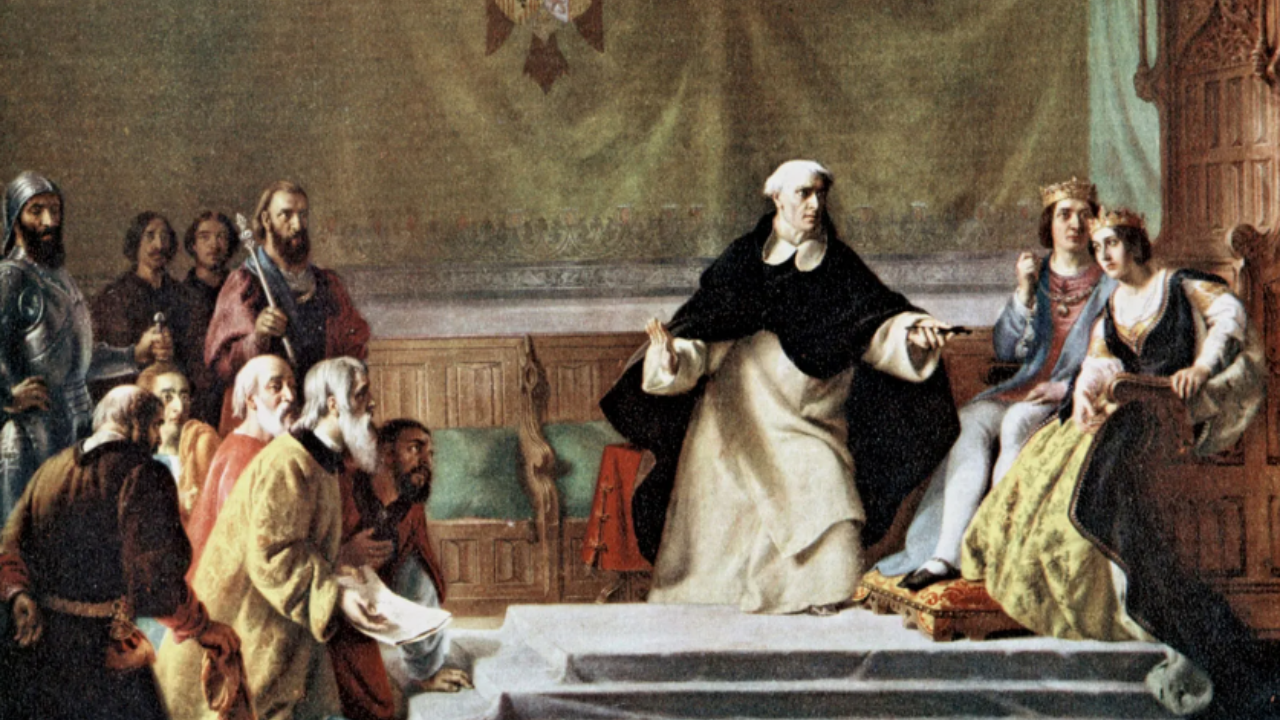
What is the Spanish Inquisition?
The Spanish Inquisition, an infamous institution synonymous with terror and religious persecution, conjures up images of dark dungeons, secret trials, and merciless interrogations and executions.
Behind the guise of religious zeal, the Spanish Inquisition reached unparalleled levels of brutality, leaving an indelible mark on countless lives.
However, amidst the darkness, there are lessons to be learned, reminding us of the importance of religious tolerance, human rights, and the relentless pursuit of justice.
Understanding the Spanish Inquisition
The Spanish Inquisition stands as a dark chapter in history, characterized by its relentless pursuit of religious conformity, devastating consequences, and its enduring reputation for cruelty.
The Spanish Inquisition was established from 1478 to 1834 as a judicial institution purportedly aimed at combating heresy in Spain.
However, its true purpose was to consolidate power within the monarchy of the newly unified Spanish kingdom, utilizing notably brutal methods to achieve its objectives.
Operating under the auspices of the Catholic Church, the Inquisition held significant authority and was responsible for identifying and punishing heresy across Europe and the Americas.
Main Targets
It gained notoriety for its harsh interrogation techniques and persecution of Jews and Muslims which resulted in approximately 32,000 executions—a grim testament to its impact.
The Spanish Inquisition cast a wide net of persecution, targeting various groups deemed threats to religious orthodoxy and political stability.
Among the primary targets were Jews, Muslims, non-Roman Catholic Christians, and individuals advocating for Church reform.
Jews
Jews faced intense scrutiny and persecution during the Inquisition, as their presence in Spain was perceived as a challenge to Christian hegemony.
Forced conversions and the imposition of strict religious observances were inflicted upon Jewish communities, leading to widespread oppression and the expulsion of thousands.
Muslims
Despite long-standing Islamic influence in the region, the Inquisition aimed to enforce Catholic uniformity and suppress perceived Muslim practices.
Many Muslims were coerced into conversions or forced to abandon their cultural and religious practices under the threat of persecution.
Christians
Non-Roman Catholic Christians, including Protestant groups, were also subjected to the Inquisition’s relentless pursuit of religious conformity.
As the Reformation gained momentum across Europe, those espousing non-Catholic beliefs were viewed as heretics and targeted for persecution, often facing imprisonment, torture, or death.
Individuals advocating for Church reform were also considered a threat by the Inquisition. \
Those challenging the Catholic Church’s practices, questioning its authority, or seeking to introduce reforms faced persecution as the Inquisition sought to maintain its power and suppress dissent within the Church.
Related articles:
An Inquisitor’s Task
During the era of the Inquisition, inquisitors would arrive in towns and offer citizens an opportunity to confess to heresy, who then faced punishments such as pilgrimages or whippings.
Those accused of heresy were subjected to forced testimony. If they did not confess, they were tortured and executed.
These heretics were denied the right to face their accusers, had no legal representation, and were often victims of false accusations.
Notorious Inquisitors
Instances of abuse of power were also rampant during this dark period. One notorious character, Count Raymond VII of Toulouse, burned heretics at the stake, even if they had confessed.
His successor, Count Alphonse, seized the accused individuals’ lands to enrich himself.
Inquisitors played a role in the mass arrest and torture of 15,000 Knights Templars in France in 1307, which led to numerous executions.
The most famous victim of this branch of the Inquisition was Joan of Arc, who was burned at the stake in 1431.
The First Grand Inquisitor
Perhaps one of the most prominent figures in Spanish Inquisition history was Tomás de Torquemada, the so-called first “Grand Inquisitor” who started it all.
Torquemada’s name became synonymous with religious extremism and cruelty.
Appointed by Queen Isabella I and King Ferdinand II in 1483, Torquemada played a crucial role in shaping the Spanish Inquisition.
Despite his infamy, Torquemada was highly regarded by Queen Isabella and King Ferdinand, who valued his unwavering loyalty and commitment to their vision of a unified Catholic Spain.
At the same time, he left behind a legacy of religious intolerance, fear, and an enduring reputation as the face of the Spanish Inquisition.
Who is Ferdinand II?
Ferdinand II played a significant role in the establishment of the Spanish Inquisition. In 1478, he and Queen Isabella I sought papal permission to establish an inquisitorial tribunal in Spain.
Pope Sixtus IV granted their request, and the Spanish Inquisition was formally launched in 1478.
Its primary purpose was to identify and eradicate heresy, particularly among the conversos (Jews and Muslims who had converted to Christianity).
The Spanish Inquisition was under the control of the Spanish monarchy, with Ferdinand II having considerable influence over its operations.
He appointed inquisitors and provided them with extensive powers to investigate, interrogate, and punish individuals suspected of heresy.
Inquisition Era Under Ferdinand
Under Ferdinand’s reign, the Spanish Inquisition became notorious for its harshness and widespread persecution.
Its targets extended beyond religious heresy to include political dissent and personal vendettas. The Inquisition targeted not only conversos but also other groups such as Protestants and witches.
The Inquisition was accompanied by strict laws, known as the Edicts of Grace and the Edicts of Faith, which compelled individuals to confess their religious beliefs and practices.
Failure to comply could result in severe penalties, including imprisonment, confiscation of property, exile, or even execution.
Ferdinand II’s support for the Spanish Inquisition played a pivotal role in shaping Spain’s religious and social landscape during his reign and beyond.
It had a lasting impact on the Jewish and Muslim populations in Spain, contributing to their persecution, expulsion, or forced conversion to Christianity.
Torture Methods
During the Spanish Inquisition, the forms of punishment were not solely intended to punish the accused heretics for their crimes but primarily aimed at extracting confessions.
Various gruesome methods were employed by certain inquisitors. However, these tactics often fell short of the inquisitors’ expectations as they sought faster results in their pursuit of extracting admissions.
Here are the horrifying forms of punishment during the Spanish Inquisition era.
The Rack
Within the dark history of the Spanish Inquisition, the rack emerges as a notorious instrument of torture and remains etched in infamy.
This merciless device subjected victims to excruciating torment: their limbs bound to a wooden plank, while a relentless crank yanked all four appendages away from their bodies simultaneously.
The relentless tension endured for hours, tearing apart nerves and muscles, leaving the unfortunate souls crippled for life.
Burning at the Stake
Burning at the stake served as a dual-purpose method, inflicting both torture and execution upon its victims. Inquisitors frequently resorted to this gruesome punishment.
Within a decade of the Inquisition’s inception, historian Hernando del Pulgar estimated that approximately 2,000 individuals had already met their fiery fate.
The Inquisition and its brutal burnings persisted for another seven centuries, leaving a horrific legacy in its wake.
It wasn’t until 1834 that the formal abolition of the Inquisition, sealed by a Royal Decree, finally brought an end to this abhorrent practice.
The Tickler
Contrary to its innocent-sounding name, the Spanish tickler brought only pain and suffering to its unfortunate victims. This device featured four or five curved metal claws at its end.
Inquisitors would employ long poles to reach victims suspended in the air or tied to vertical racks, raking the claws across their flesh, tearing through muscle, and even fracturing bones.
The torment would commence on limbs and escalate to the torso, maximizing the excruciating levels of agony.
The Knee Splitter
The knee splitter struck terror into the hearts of its victims during the Spanish Inquisition.
This terrifying device functioned as a vice, clamping down upon the victim’s leg with menacing spikes, resulting in immobilization and excruciating pain.
While rarely fatal, the knee splitter rendered its victims permanently incapacitated, rendering their legs useless.
Although adaptable to other parts of the body, the Inquisition’s preference was to inflict this bone-chilling torture upon the limbs.
Crown of Death
The Crown of Death symbolized the horror of the Spanish Inquisition. This torture device featured a vice-like structure, enveloping the victim’s head with a top cap pressing against the skull, while their chin rested upon a metal bar.
As inquisitors tightened the screw atop the device, the victim’s skull was slowly crushed, causing teeth to shatter and, in extreme cases, leading to the gruesome expulsion of eyeballs from their sockets, ultimately resulting in certain death.
Water Cure
The Water Cure emerged as a harrowing method of torture.
Strapped down, victims were subjected to the forced intake of copious amounts of water, often reaching up to 30 pints in one session.
Strappado
The Strappado was one of the most popular methods of torture during the Spanish Inquisition.
Its straightforward yet brutal implementation made it a commonly employed tool in the Inquisition’s arsenal of torment.
By tying the victim’s hands behind their back and suspending their full weight from their wrists using a pulley system, excruciating pain was inflicted.
Weights were often attached to the victim’s feet, intensifying the agony and ensuring dislocation of the extremities.
The Headless Donkey
The Headless Donkey stood as a twisted symbol of torment during the Spanish Inquisition.
Victims were compelled to sit on a wooden wedge, often equipped with spikes, while their feet dangled on either side of the “saddle.”
In some instances, weights were added to their feet, exacerbating the pain and causing open wounds, profuse bleeding, and, over time, even death.
Waterboarding
Waterboarding, known as “tormente de toca” in the Spanish Inquisition, represented a method of torture that simulated drowning.
The victim would be tightly bound to an inclined board, their face covered with a cloth, and water poured over it.
This induced a sensation of suffocation and drowning, instilling intense fear and panic in the suspected heretic.
The severity of the torture was measured by the number of jars of water consumed, often reaching six to eight.
The End of a Horrific Era
The Spanish Inquisition came to an end through a series of political and social changes. King Ferdinand VII, whose reign saw the restoration of absolutism and the suppression of opposition, died in 1833.
His fourth wife, Maria Cristina de Borbón, acted as regent and aligned herself with the liberal faction.
With the support of the liberals, Maria Cristina issued a decree of amnesty and brought about the Royal Statute of 1834, which established a new legislature.
Finally, on July 15, 1834, Maria Cristina signed a Royal Decree officially abolishing the Spanish Inquisition, marking a significant departure from Ferdinand’s absolutist rule.
Frequently Asked Questions
What is heresy?
It refers to beliefs conflicting with established religious customs. Heretics were individuals who espoused such beliefs. Christianity, Judaism, and Islam have historically responded to heresy with punishments ranging from excommunication to capital punishment.
What is a “converso”?
Conversos were Spanish Jews who converted to Christianity due to persecution and expulsion in the late 14th and early 15th centuries. Despite their conversion, they were still considered Jews by many Catholics because they maintained ties to Jewish communities and occupied professions previously dominated by Jews.
What happens to the person after being tortured?
After enduring torture during the Spanish Inquisition, a person faced a cruel fate. Once they confessed to their alleged sins, it doesn’t end there. The Inquisition was merely a means to extract confessions. The consequences that followed varied from losing all possessions to being subjected to further torture and, ultimately, death.
Takeaway
The Spanish Inquisition left an indelible mark on religion, history, and the concept of human justice.
Its impact reverberated through the centuries, shaping Spain’s religious landscape and leading to the persecution, expulsion, or forced conversion of Jews and Muslims.
The Inquisition’s legacy serves as a stark reminder of the dangers of religious intolerance and abuse of power.
Today, the actual torture devices used during that dark period can be found in various museums and historical collections, providing tangible evidence of the Inquisition’s brutality and serving as a solemn reminder of the importance of upholding human rights and religious freedom.
If you found this article informative, consider subscribing to our YouTube channel for more historical and thought-provoking content.
More articles:




Discussion about this post